


Listen to the article
Adults permanently registered in Navoiy and Chirchiq will be required to submit annual declarations of total income and expenditure for the years 2026 and 2027, under a pilot scheme whose procedural rules were formalised by a Cabinet of Ministers resolution published on 20 October.
The obligation applies to individuals aged 18 and over who are registered at a permanent address in either city. Two categories are exempt: people who have been registered in the cities for fewer than six months, and employees hired by the tax authority itself during the reporting year.
The pilot was originally mandated by a presidential decree dated 10 December 2025, which instructed tax officials and registered individuals in Navoiy and Chirchiq to test the practice of filing comprehensive annual income declarations. The Cabinet resolution of 19 October 2026 approved a temporary administrative regulation setting out exactly how that process will work.
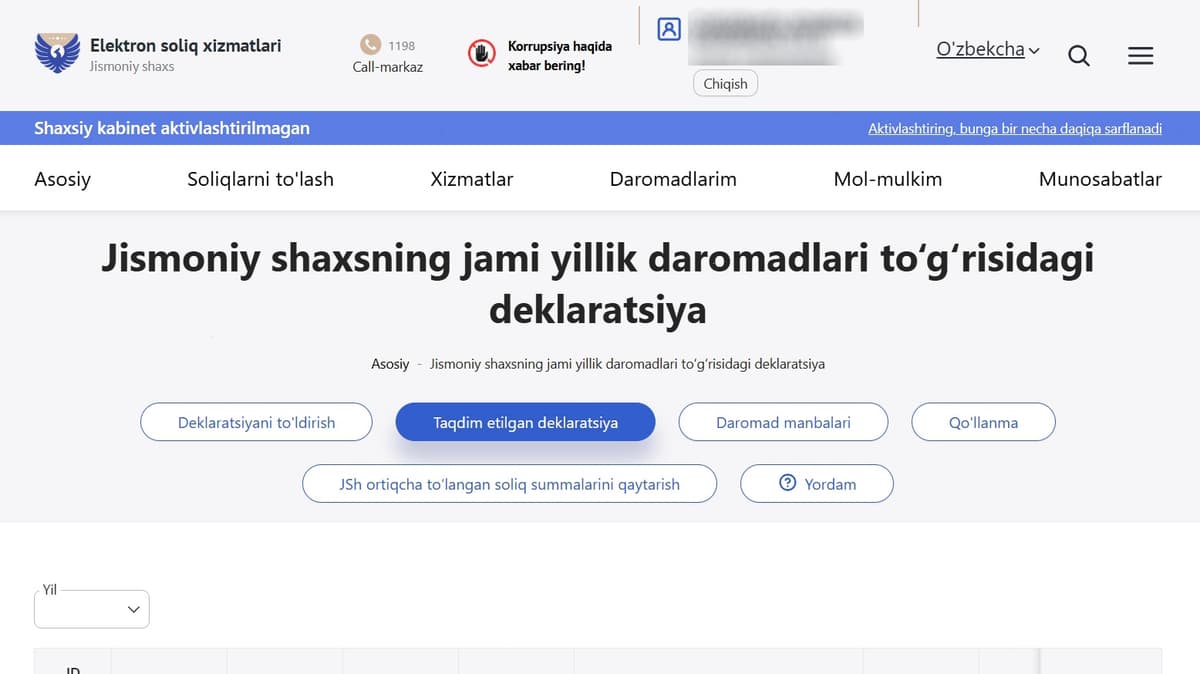
Declarations must be submitted through the Tax Committee’s Electronic Tax Services portal at my3.soliq.uz or through the Soliq mobile application. The deadline for the 2026 declaration is 1 April 2027; the 2027 declaration must be filed by 1 April 2028. The tax authority is required to send a notification to each filer at least one month before the relevant deadline.
The declarations will cover income from employment, property, material benefit and other sources as defined under Articles 371, 375, 376 and 377 of the Tax Code, as well as expenditure on real estate, movable property and liabilities including taxes, utility bills and loan repayments.
A notable feature of the pilot is its explicitly non-punitive design: the resolution states that no legal enforcement measures will be applied on the basis of the adjusted tax base that emerges from the declarations. The exercise appears intended to test administrative systems and gather data on household finances before any broader rollout, rather than to generate immediate tax assessments or penalties.
Navoiy, a city in central Uzbekistan built around the country’s major mining and chemical industries, and Chirchiq, an industrial centre in the Tashkent region, together represent a cross-section of urban working populations, making them a practical testing ground for a mechanism that could eventually be extended nationwide.