


Listen to the article
The Collective Security Treaty Organization announced early Thursday that it will dispatch peacekeeping troops to Kazakhstan, where demonstrations against fuel price increases have escalated into widespread unrest, forcing a state of emergency and the collapse of the government.
Armenian Prime Minister Nikol Pashinyan, the current CSTO chair, announced the decision on Facebook, saying the alliance had weighed threats to Kazakhstan’s national security and sovereignty before acting. “In view of the address of President of Kazakhstan Kassym-Jomart Tokayev and considering the threat to national security and sovereignty of the Republic of Kazakhstan, caused in particular by interference from the outside, the CSTO Collective Security Council in accordance with Article 4 of the Collective Security Treaty made the decision to send CSTO Collective Peacekeeping Forces to the Republic of Kazakhstan for a limited period with the aim of stabilization and normalization of the situation in this country,” Pashinyan wrote.
He added that the forces would remain “for a limited period of time in order to stabilize the situation.” The statement did not specify the size of the contingent or which member states would contribute troops.
How the protests began
The unrest started on 2 January in Zhanaozen, a city in the oil-rich Mangystau region, when drivers staged demonstrations against sharp price increases for liquefied petroleum gas. The protests spread quickly to the nearby port city of Aktau and then to the western petroleum hubs of Atyrau, Aktobe and Oral before reaching a nationwide scale.
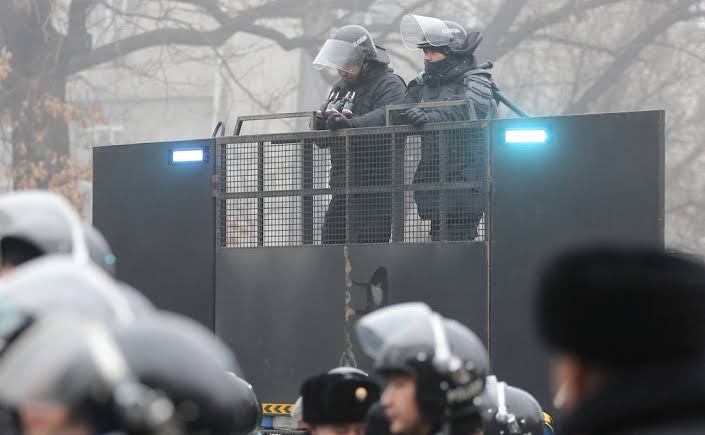
By Wednesday, Tokayev said roughly half of Kazakhstan’s territory was engulfed in riots, with the situation described as “especially difficult” in Almaty, the country’s largest city and former capital. He declared a state of emergency in Almaty and the Mangystau region running from 5 to 19 January, and imposed a curfew in Almaty, where thousands had taken to the streets. Police deployed stun grenades and teargas; demonstrators responded with stones.
Tokayev accepted the government’s resignation by presidential decree as the protests broadened, and subsequently extended the state of emergency to the entire country. He said Wednesday he intended to “act as tough as possible” given what he called an “extremely tense” situation.
Government moves to contain economic grievances
In a parallel measure, the government announced price controls on LPG, gasoline, diesel fuel and basic food products, to remain in force for 180 days. The move addresses the immediate trigger of the protests but comes after days of violence that have already pushed the crisis well beyond its economic origins.
The CSTO’s invocation of Article 4 — the alliance’s collective defence clause — marks a significant escalation of the international dimension of the crisis. Pashinyan’s reference to “interference from the outside” as a contributing factor was not elaborated upon in the statement, and no evidence for that claim was provided in the announcement.