



Listen to the article
More than four-fifths of employers in Uzbekistan are satisfied with the quality of graduates produced by the country’s universities, according to a nationwide survey designed to measure how well higher education aligns with labour-market needs. But the same research reveals that nearly half of those employers have no ongoing relationship with the institutions whose graduates they hire, and that practical training remains the most widely cited shortcoming across both universities and technical colleges.
The survey covered more than 3,700 employers drawn from all regions of the country. Participants assessed graduates from 169 universities and 591 technical colleges. Among employers who had hired university graduates, 86.8 percent said they were satisfied with the level of preparation. Satisfaction was markedly lower for technical-college graduates, where only 65.1 percent of employers gave a positive assessment.
Practical training the dominant complaint
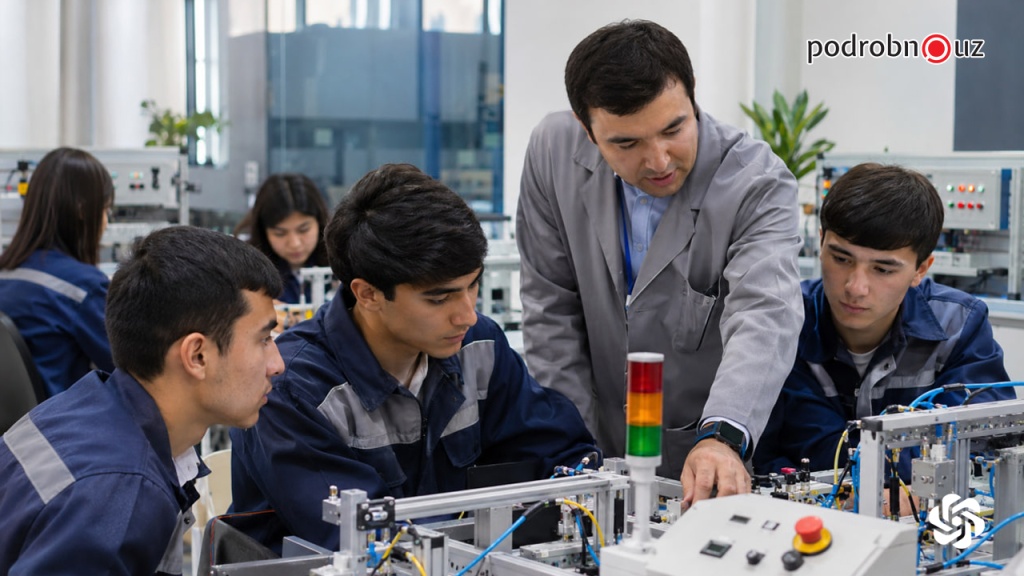
Across both types of institution, insufficient hands-on preparation was the most frequently raised concern. Some 40.7 percent of respondents said universities needed to strengthen the practical component of their programmes, while the figure rose to 53.7 percent for technical colleges — suggesting the gap between theory and workplace application is more acute in vocational education.
The survey also found that 45.2 percent of employers reported having no regular collaboration with relevant universities. That figure points to a structural disconnect: employers are absorbing graduates without having shaped the curricula that produced them, and institutions are designing programmes without sustained input from the businesses their students will enter.
AI skills and adaptability seen as future priorities
Looking ahead, survey participants identified growing demand for workers capable of operating artificial intelligence tools, deploying digital solutions and handling modern equipment. Employers also flagged creative thinking and the ability to acquire new technical skills quickly as competencies that will become more valuable in the coming years.
Despite the forward-looking emphasis on technology, the qualities employers currently prize most when hiring remain traditional: responsibility and discipline were cited most frequently as the key attributes they seek in both university and technical-college graduates.
Policy response in preparation
The survey’s organisers said the findings would be used to develop proposals for reforming educational programmes, expanding dual-education models — in which students divide time between classroom instruction and workplace training — and deepening institutional ties between colleges and employers. No timeline for those proposals was given.
The results come as authorities have separately announced an expansion of international professional-qualification programmes in state technical colleges. Under that initiative, an additional 3,500 students are set to join the scheme in the 2026–2027 academic year, bringing total enrolment to 5,000.