



Listen to the article
A 1,600-square-metre plot in Tashkent’s Yashnabad district that once held a football pitch and children’s play equipment has stood behind a metal construction fence for more than four years, with no building started and no public explanation given to the families who used it. Residents of the Mumtoz mahalla have now formed an initiative group demanding the fence come down, the land be cleared and the recreational space be restored.
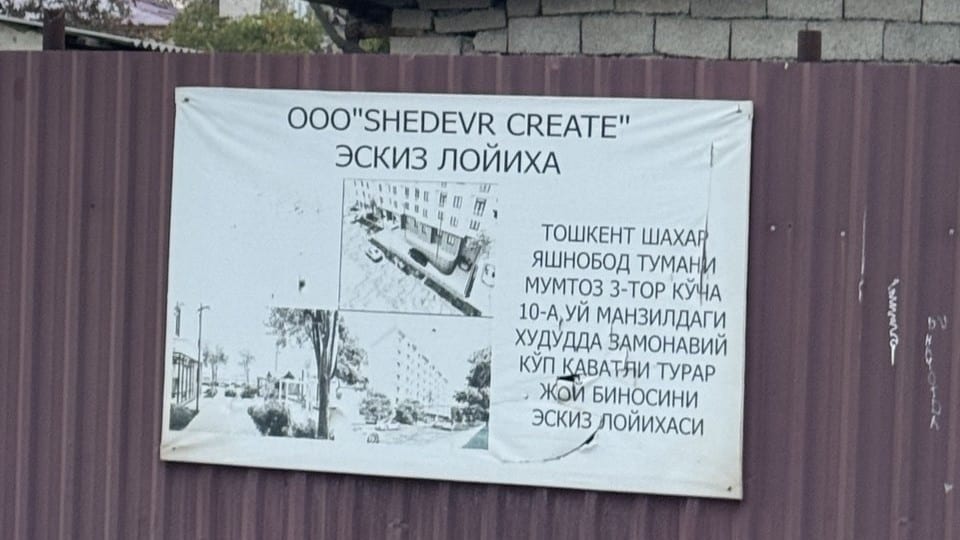
The plot, at 3rd Mumtoz Lane, house 10a, was enclosed in 2021. A project sketch displayed on the hoarding showed a multi-storey residential block, but construction has never begun. Residents say rubbish has accumulated inside the perimeter and that stray dogs shelter in a structure on the site — a claim supported by video footage the group provided. With the playground gone, children from neighbouring buildings play beside a roadway because no comparable alternative exists nearby.
A Company With One Employee and a D-5 Stability Rating
A cadastral certificate generated on 4 November 2026 through Uzbekistan’s unified state services portal my.gov.uz identifies the rights-holder for cadastral parcel 10:04:40:02:01:0144 as the limited liability company SHEDEVR CREATE — the same name displayed on the construction hoarding. The company was registered on 4 June 2021, the same year the fence appeared. According to its public profile on the business information service iHamkor, SHEDEVR CREATE (tax identification number 308555940) lists construction of residential buildings as its primary activity, carries a declared charter capital of 20 million soums, employs one person, and holds a stability rating of D-5, described by the service as low.
The cadastral certificate classifies the object as a non-residential building or structure, yet records the built-up area as zero — an internal inconsistency that raises questions about what right, exactly, is registered: over the land parcel, over a structure on it, or over some other form of immovable property. The certificate also carries a note that the State Register contains no record of registration of immovable property of the specified type of right, leaving the legal basis for the company’s claim to the site unclear.
A Tax Freeze and a Renovation Programme
The most consequential detail in the November 2026 cadastral record is a registered encumbrance. Under restriction number YAST-58731287, dated 5 October 2026, the Yashnabad district tax inspectorate imposed an asset freeze on the property under order number 26839743. The freeze predates the residents’ complaint by a month and raises a separate question about whether any construction could lawfully proceed while the encumbrance remains in force.
The plot also falls within a larger urban renewal zone. Tashkent mayor’s decree number 522-14-0-Q/24 designated a 3.2-hectare territory in Mumtoz mahalla for comprehensive development and renovation. A comparison of the boundary coordinates published in the decree’s annex places the disputed parcel inside that perimeter. Inclusion in a renovation zone does not, however, automatically authorise high-rise construction on any individual plot within it; specific development parameters and permitting documents must be obtained separately.
Documents published on the Tashkent Invest website show that a qualification round for investors in the Mumtoz renovation was held between 20 and 27 November 2024, with a single application received. That applicant met the stated criteria and was admitted to the next stage, with proposal evaluation scheduled for 4–25 December 2024. The published extract does not name the applicant, and the outcome of the final competitive stage has not been made public.
The same decree required Tashkent Invest and the Yashnabad district administration to organise an open public discussion of the master plan and development concept with residents and property owners within one month of the competition’s conclusion. Whether that meeting took place is not known. The decree also mandated an inventory of recreational areas, social infrastructure and engineering networks within the renovation zone before work began — a requirement directly relevant to the playground that was fenced off three years before the decree was issued.
The initiative group is asking competent authorities to verify whether SHEDEVR CREATE holds valid construction permits for a residential high-rise, to clarify the legal origin of its rights over the parcel, and to explain the effect of the tax-authority freeze on any planned development. Residents are also proposing that, depending on the plot’s legal status, the land could be incorporated into the national greening programme Yashil Makon as a small park and safe play area. Until the rights questions are resolved and the renovation process is made transparent, the fence is likely to stay — and the children to keep playing beside the road.