


Listen to the article
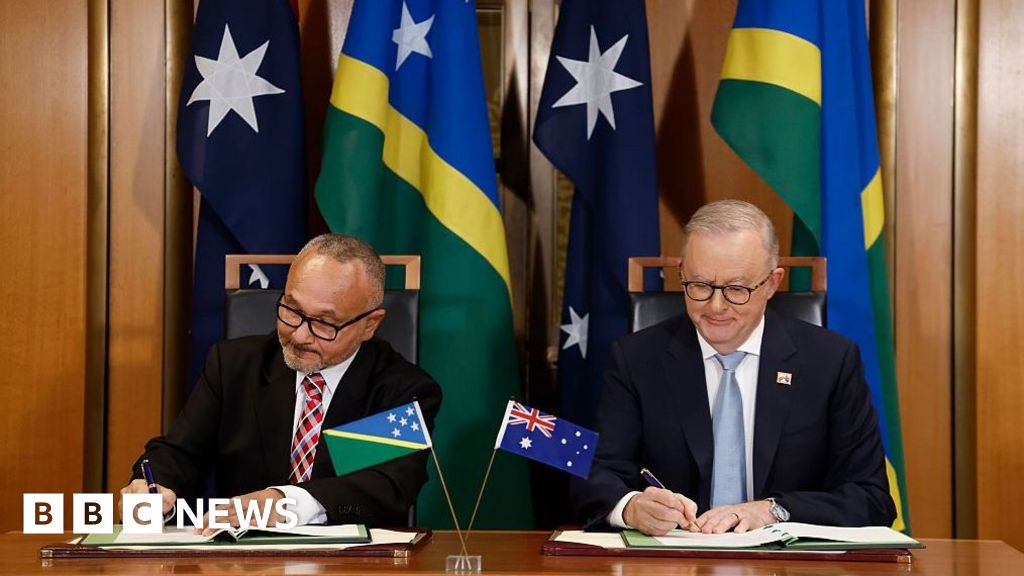
The Solomon Islands has signed a security treaty with Australia that its prime minister described as a historic reset, days after Australian media reported that Honiara had informed Beijing it would not renew a controversial policing and security pact signed with China in 2022.
At a press conference in Canberra on Wednesday, Australian Prime Minister Anthony Albanese and Solomon Islands Prime Minister Matthew Wale said the new treaty would make Australia the Pacific nation’s “security partner of choice.” Wale was accompanied by two dozen Solomon Islands MPs, a delegation size that both leaders said demonstrated strong parliamentary backing for the agreement after years of political instability rooted largely in disagreement over Honiara’s relationship with Beijing.
“Those days are done, gone,” Wale said, referring to a period in which the Solomon Islands had been, in his words, a point of “uncertainty and doubt in the region.” Albanese framed the deal in terms of mutual benefit: “Backing our Pacific neighbours is an investment in Australia’s own security and our own prosperity,” he said, adding that the treaty would “completely respect Solomon Islands sovereignty and its right to make its own decisions.”
The China pact it replaces
The 2022 security agreement was concluded under then-Prime Minister Manasseh Sogavare, now the opposition leader. Its full text was never publicly released, but leaked excerpts showed it gave China extensive involvement in security and policing, including the right to deploy its own officers to the islands and provisions that analysts said amounted to a quasi-military base. Lowy Institute Research Fellow Dr Connor Graham described it to the BBC as a “massive coup” for Beijing whose unprecedented scope alarmed governments across the Pacific and in Washington.
The pact is understood to expire in April 2027. On Tuesday, Australian media reported that Honiara had told Beijing it would not renew it, though Wale declined to confirm the details at Wednesday’s press conference, citing a non-disclosure agreement. He said only that “ongoing discussions” with China were under way. China’s foreign ministry spokesman Guo Jiukan neither confirmed nor denied the termination, saying: “There is no element of geopolitical rivalry or bloc confrontation in cooperation between China and Pacific island countries, including the Solomon Islands.”
What the new treaty requires
Under the agreement, the Solomon Islands commits to consulting Australia in advance on critical infrastructure decisions and to limiting security cooperation to members of the Pacific Islands Forum — a body of which China is only a dialogue partner, not a full member. Honiara also commits to keeping sensitive infrastructure “free from militarisation, any form of foreign interference or unauthorised access” and to barring its territory from being used for any foreign military or security base.
In return, the Solomon Islands will receive support for its free education system and sports programmes, improved visa arrangements, and backing for affordable and renewable energy and infrastructure development. The ABC reported earlier this week, citing leaked text messages, that the package included more than A$980 million in additional funding; the BBC said it had not independently verified those messages.
Analysts: a significant shift in Pacific balance
Dr Graham told the BBC that Wednesday’s treaty delivered “an enormous win for Canberra” and “closes the loop” on a series of security agreements Australia signed with Pacific nations in the aftermath of the 2022 China deal. “That was the thing that put fear in the hearts of diplomats in Washington and Canberra,” he said.
William Yang, senior analyst for North East Asia at the International Crisis Group, said the end of China’s “flagship” Pacific security arrangement and the signing of the new treaty reaffirmed what he called the Pacific’s “longstanding consensus-based decision-making model, especially in the security space.”