



Listen to the article
Pastor Doug Wilson wants to repeal the amendment that gave American women the right to vote. He leads a small but growing denomination, counts the US Secretary of Defence as a congregant, and has recently led prayer services inside the Pentagon. His critics — including mainstream Christian clergy — call his views misogynistic and extreme. Wilson himself calls them biblical.
“Patriarchy is in accordance with the way God made the world,” Wilson told the BBC from his base in Moscow, Idaho, describing a society led by men as “a very great blessing.” A self-described Christian nationalist, he believes the United States should be a theocracy, with gay sex criminalised, abortion outlawed, and people of other faiths barred from public office.
At the centre of his theology is a conviction that the 19th Amendment — ratified in 1920 and guaranteeing women the right to vote — should be repealed in favour of what he calls “household voting,” a system in which the head of the home, typically a man, casts a ballot on behalf of the entire family. Within his own church’s internal elections, just seven per cent of votes are cast by women. Wilson acknowledged to the BBC that the arrangement gives men “outsized influence.” He added, however, that women in his own family do vote in civic elections — to counter the votes of liberals, he said.
A fringe view with a prominent connection
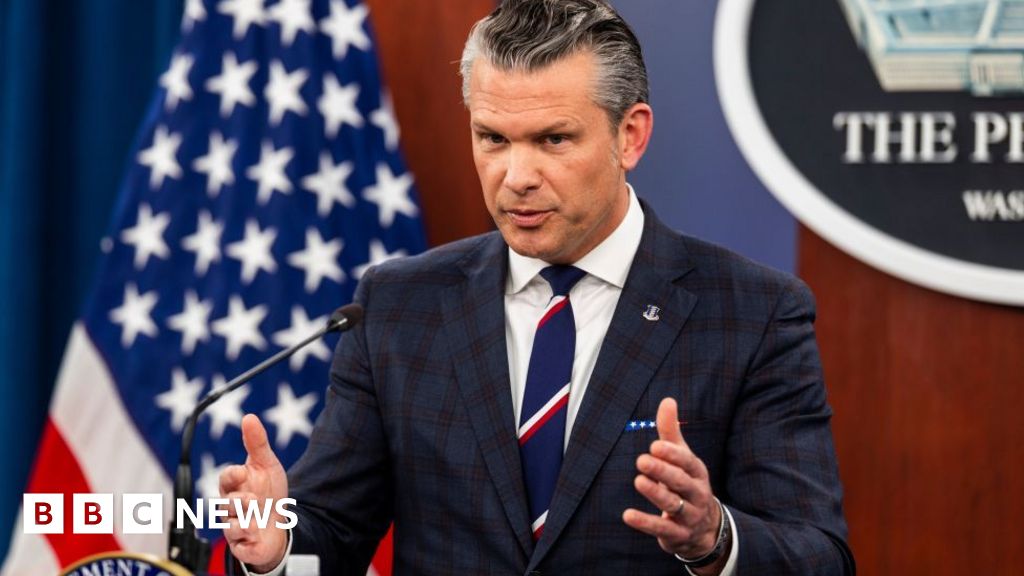
Wilson co-founded the Communion of Reformed Evangelical Churches, known as the CREC, which now has around 150 congregations in the United States — a fraction of the country’s roughly 350,000 Christian churches, but a number Wilson says continues to rise. The denomination’s profile has been lifted considerably by its association with Pete Hegseth, the Secretary of Defence appointed by President Donald Trump.
A Pentagon spokesperson confirmed to the BBC that Hegseth is “a proud member” of a CREC-affiliated church and that “the secretary very much appreciates many of Mr Wilson’s writings and teachings.” Wilson describes their relationship as “warm” but primarily pastoral rather than political. He led a prayer service at the Pentagon in mid-November, at which Hegseth addressed him directly: “Thank you for your leadership, for your mentorship, for the things you’ve started, the truth you’ve told, your willingness to be bold.”
Wilson told the BBC that other members of the current administration also worship at the Washington DC branch of his church network.
Mainstream Christians push back
The vast majority of American Christians reject Wilson’s positions. The Reverend Canon Dana Colley Corsello, vicar at Washington National Cathedral, told the BBC she sees no scriptural basis for them. “In my mind, there is no biblical precedent or standing for what he has proposed,” she said. “I’m married, I have a husband, I have children. My husband and I are complete equals in everything we do.”
Corsello also pointed to recent midterm election results as evidence that the broader public has not embraced the agenda. “Cultural issues did not translate in this election,” she said. “When people are preaching love, empathy, inclusion… that actually resonated with people.”
Younger pastors push further, faster
Wilson himself distances himself from two younger conservative pastors who have adopted more aggressive timelines. Dale Partridge, who has around 900,000 followers across social media, posted in February that “we will repeal the 19th Amendment within ten years” and has claimed that “the majority of women are not capable of responsible voting” because too many of them are liberal. Joel Webbon, whose New Christian Right YouTube channel has more than 190,000 subscribers, has said women’s “desires are wicked” and called for their voting rights to be removed.
Wilson credits himself with having “broken the ice” for this kind of politics, according to Partridge, but he is dismissive of the two men’s approach. “Those guys have overshot by a long way,” he said. “They are disruptors and basically rage baiting.”
Wilson’s own stated position is that repealing the 19th Amendment is “low” on his list of priorities and could take a century or more — but he was unambiguous: “we do think it.”
Scholars see a longer game
Julie Ingersoll, a professor of religious studies at the University of North Florida, told the BBC that Wilson’s worldview holds that women should be in complete submission to men across every aspect of their lives. She drew a direct parallel with the decades-long campaign against abortion rights. “Thirty years ago, people would have said, oh, they’re not gonna undo abortion rights,” she said. “But they chipped away and they kept chipping away until they were able to overturn it. And I see this as directly parallel.”
Repealing the 19th Amendment would require a proposal from two-thirds of both chambers of Congress, or two-thirds of state legislatures, followed by ratification by three-quarters of states — a threshold legal scholars consider essentially insurmountable in the near term.
Kelly Marino, an associate professor at Sacred Heart University who studies women’s suffrage, told the BBC that the conversation itself carries consequences regardless of legislative prospects. She linked the movement to a broader post-pandemic “craving for tradition,” visible in the popularity of “tradwife” and “soft girl” identities online, and noted that periods of feminist progress have historically provoked organised backlash.
Wilson’s network has also expanded internationally. The CREC now has more than 30 churches outside the United States, including congregations in Poland, Japan, Brazil and, most recently, England. Brazil has seen its own movement of right-wing influencers pressing for the removal of women’s suffrage, some using religious language. Wilson says the core beliefs of CREC churches are the same wherever they operate.