



Listen to the article
Validators on Tashkent city buses have received a software update that changes what passengers see when they tap a bank card more than once on the same journey. The update, being rolled out in stages by transport operator Tashtrans, introduces a two-option menu on the validator screen for any repeat tap of a bank card.
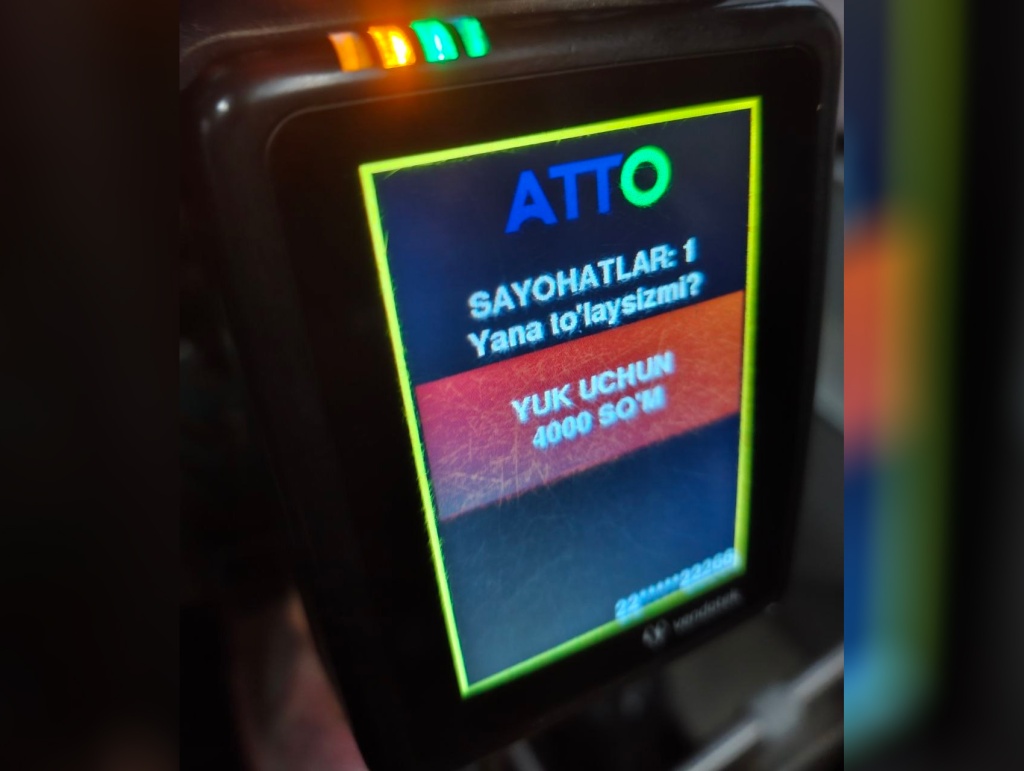
After the first payment, tapping the same bank card again now displays two choices: Sayohat uchun — 2,500 so’m (“For a journey”) and Yuk uchun — 4,000 so’m (“For luggage”). Passengers paying for a second or subsequent traveller using one card must actively select the upper option each time. Failing to do so — and allowing the device to default or selecting the wrong line — will result in a charge of 4,000 soums, the baggage rate, rather than the 2,500-soum fare.
The rules work differently for ATTO transport cards and virtual ATTO cards. According to information on the operator’s official website, each ATTO card is registered to a single passenger. When an ATTO card is tapped a second time, the validator displays only the luggage option — Yuk uchun — 4,000 so’m — because the card cannot be used to cover another person’s fare. Passengers wishing to pay for multiple riders must therefore use separate ATTO cards or switch to a bank card.
Tashtrans has noted that the software rollout is gradual, meaning some buses in the fleet are still running the previous interface and will not yet show the new menu.
Baggage rules and fares unchanged
The update affects only the validator interface, not the underlying tariffs. Since 1 October 2026, a single bus journey paid by bank card or transport card costs 2,500 soums, while carrying oversized luggage costs 4,000 soums. Both figures predate this interface change.
Tashtrans also restated the existing rules on what counts as chargeable baggage. Carry-on items and musical instruments measuring up to 60 × 40 × 20 centimetres and weighing no more than 20 kilograms travel free. Items that exceed those dimensions — up to 100 × 50 × 30 centimetres — or elongated objects between 150 and 200 centimetres in length, or any baggage weighing more than 20 kilograms regardless of size, require a paid baggage ticket at the established tariff.
The fare of 2,500 soums itself represents an increase from the previous electronic-payment rate of 1,700 soums, a rise that predates the current interface update.