



Listen to the article
An assembly marking International STEAM Education Day and World Science Day for Peace and Development brought together government officials, international organisations, educators, researchers and young innovators to recognise the country’s best projects in science, technology, engineering, arts and mathematics, and to debate how to embed the approach across Uzbekistan’s entire education system.
The event’s centrepiece was the presentation and award of the top innovative STEAM project in each of the five disciplines. In science, Bektosh Ruziqulov, a pupil at the Presidential School in Navoi, was recognised for research into soil materials and their microstructural properties. The technology prize went to a team from Bukhara State Technical University — Rukhshona Rustamova, Zarina Ruzimуrodova and Aziza Alimova — for a web platform designed for workers and students. The engineering award went to fellow Bukhara State Technical University representatives Asliddin Juraev, Sardor Orziev and Qadam Ruziqulov for a machine that lays concrete lining in small-scale irrigation canals. In the arts category, Rukhshora Ramazonova, a pupil at the Presidential School in Bukhara, was honoured for a project converting plastic bags into ecologically clean fashion accessories. The mathematics prize was awarded to Avazbek Jalilov, deputy director for academic affairs at Specialised Boarding School No. 1 in Guliston, for a project automating school timetable generation using Microsoft Excel.
Methodology guides and a call for post-competition support
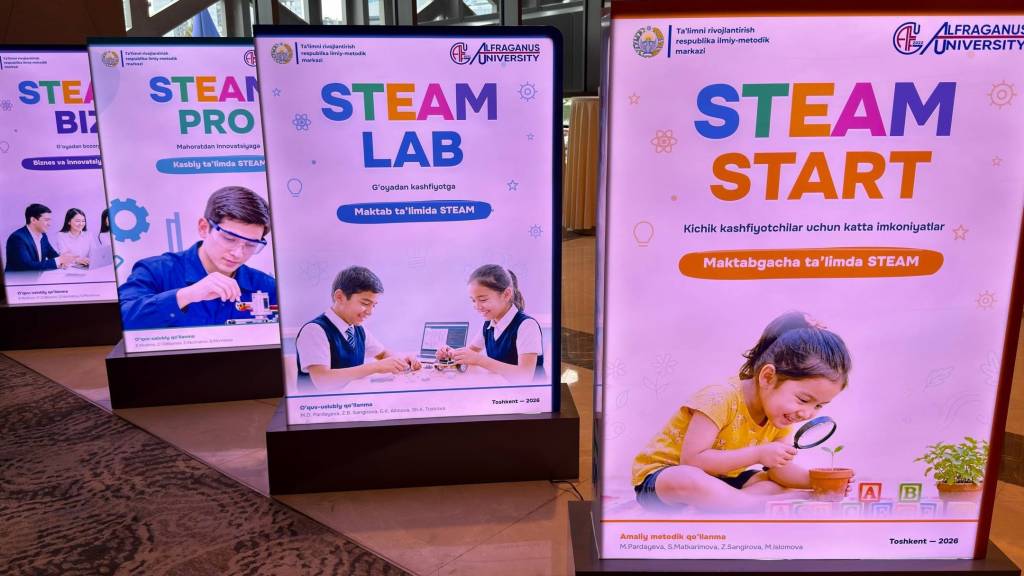
Shahzodbek Kurbaniуazov, director of the Republican Scientific-Methodological Centre for Education Development, told the assembly that his centre had produced a series of STEAM methodological guides covering every stage of continuous education, from pre-school through general secondary, vocational training and on to business and innovation. The four guides carry the titles STEAM START, STEAM LAB, STEAM PRO and STEAM BIZ. He said their value would depend on how widely they were actually used in classrooms and how broadly they spread among teachers. “STEAM does not limit the learner to absorbing ready-made information: it encourages asking questions, searching, conducting experiments, working in a team and turning one’s own idea into a practical solution,” Kurbaniуazov said, adding that strengthening cooperation between education, science, industry and entrepreneurship, and identifying and supporting promising STEAM projects, was a shared obligation.
Azizbek Ismoilov, rector of Alfraganus University, pressed for sustained backing of promising projects beyond the competition stage. “Young researchers need to learn to support every proposal with evidence, to acknowledge errors in experiments and to refine solutions,” he said. He called for joint projects with defined tasks, partners and expected outcomes to emerge from the connections formed at the assembly, and argued that scientific mentoring, pilot testing and dialogue with manufacturers would allow young authors to improve their work.
International organisations stress inclusion
Rekhina Maria Castillo, head of UNICEF’s office in Uzbekistan, focused on quality and inclusive education, warning that new technologies must reduce existing gaps rather than widen them. “Every child must have the opportunity to discover and develop their abilities,” she said. “What matters most to us is supporting every child’s access to quality, inclusive and modern education regardless of where they live or what resources they have.”
Sara Noshadi, head of UNESCO’s office in Tashkent, argued that the complexity of contemporary challenges — climate change, technological disruption, social pressures — made single-discipline knowledge insufficient. “STEAM makes it possible to connect different subjects, to direct pupils toward independent research and toward creating new solutions,” she said, adding that creativity, ethical responsibility and humanistic values must develop alongside technical knowledge. “The real value of innovations in education is measured by their contribution to human life, social wellbeing and sustainable development.”
The assembly also featured a presentation by winners of the FIRST Global Challenge 2026 international robotics competition, experience-sharing sessions with international and local experts, and an exhibition of innovative STEAM projects.