


Listen to the article
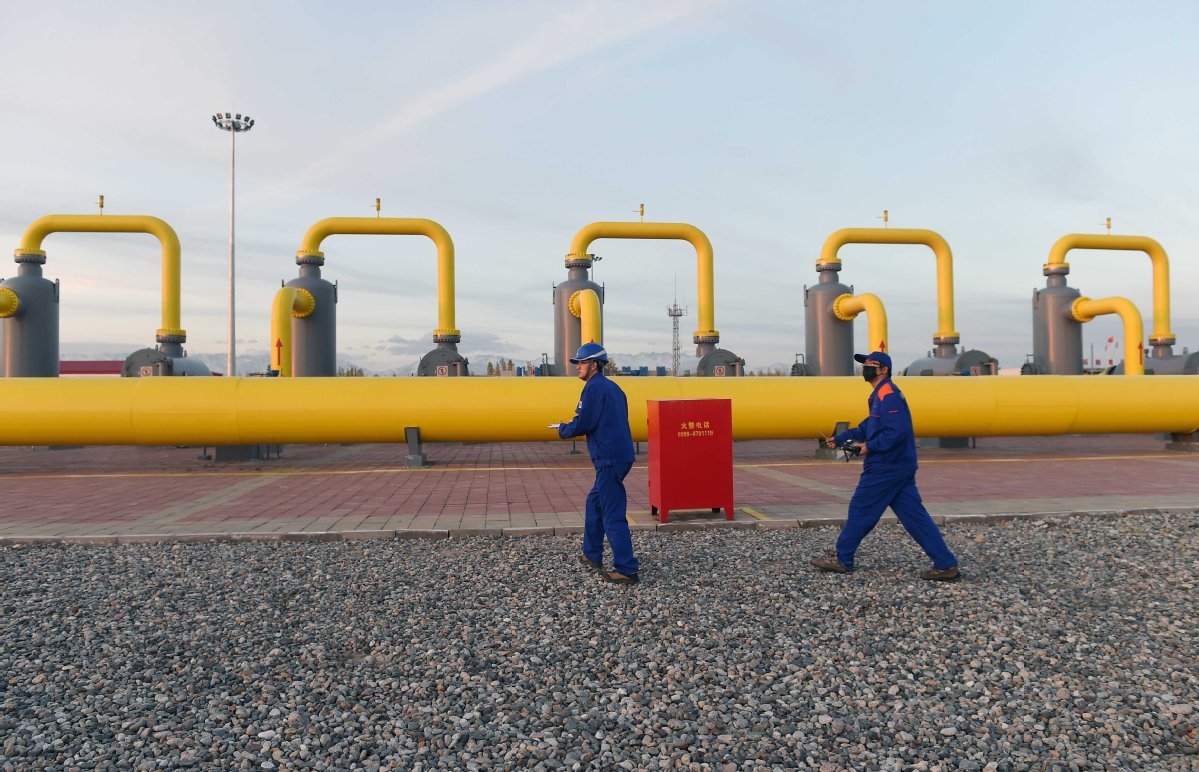
Turkmenistan has fully repaid the Chinese credit it took out to finance construction of the Turkmenistan-China gas pipeline and development of the Galkynysh gas field, Deputy Prime Minister Shakhym Abdrakhmanov announced at a government teleconference on June 11. The Xinjiang branch of China Development Bank notified Ashgabat that the debt had been cleared on June 8, Abdrakhmanov said.
President Gurbanguly Berdymukhamedov framed the repayment as proof of national economic strength. “Full and timely repayment of foreign credit shows that Turkmenistan is an economically powerful state that pursues a responsible approach to fulfilling its obligations,” he said at the televised meeting. No figures were disclosed by the government. State media have cited $8 billion as the cost of the pipeline, Galkynysh development and related export infrastructure, while some scholars have put the total closer to $10 billion.
One customer, one commodity
The debt clearance removes a significant financial burden, but it does not resolve the structural conditions that made Turkmenistan vulnerable in the first place. A detailed investigation by transparency organisation Crude Accountability found that hydrocarbons accounted for 94.6 percent of Turkmenistan’s exports in 2014 — the last year the International Monetary Fund published the relevant data — up from 83.8 percent in the final years of President Saparmurat Niyazov’s rule before his death in 2006. Crucially, those hydrocarbon exports flow overwhelmingly to a single buyer: China.
Crude Accountability’s report also characterised Turkmenistan as “a model kleptocracy, where state revenues are embezzled and billions of dollars wasted by President Berdymukhamedov on vanity projects,” and devoted a chapter to the offshore vehicles it says the country’s two ruling clan-families have used to move wealth abroad.
The World Bank has declined to include Turkmenistan in its flagship biannual Global Economic Prospects survey, citing “lack of reliable data of adequate quality” and stating it is “currently not publishing economic output, income, or growth data for Turkmenistan.” Venezuela is the only other country to receive the same treatment.
FDI without diversification
A separate academic paper by Polish scholars Natalia Iwaszczuk, Jacek Wolak and Aleksander Iwaszczuk examined the relationship between foreign direct investment inflows and economic growth in Turkmenistan. Their data show the country ranked fifth among post-Soviet states — excluding EU members Lithuania, Latvia and Estonia — for FDI inflows in 2019, attracting $2.2 billion, though the trend has been declining. The researchers found, however, that standard assumptions about FDI driving economic growth were “not confirmed” in Turkmenistan’s case. They called on policymakers to diversify investment inflows by improving human resources, adopting transparent economic policy and creating incentives for non-gas sectors — conditions on which, the paper implies, Turkmenistan is currently falling short.
Russia’s charm offensive
Russia’s ambassador in Ashgabat, Alexander Blokhin, this week praised both countries’ handling of the coronavirus pandemic, claiming Turkmenistan had “managed to weather this period very respectably” with minimal damage to its main economic sectors. His remarks came as Russia entered a third wave of mass infections; Turkmenistan, for its part, has officially claimed zero cases throughout the pandemic. Blokhin said non-gas trade between Russia and Turkmenistan grew 40 percent last year to reach $970 million, rising to $2 billion when gas sales to Gazprom are included. Based on Gazprom’s reported annual purchases of 5.5 billion cubic metres, that implies a price of $187 per 1,000 cubic metres — the same figure China is reported to pay.
Blokhin also addressed speculation that the recently announced Turkmenistan-Azerbaijan agreement to jointly develop the Dostluk oil and gas field in the Caspian Sea could pave the way for a Trans-Caspian Gas Pipeline. He sought to close down that possibility, describing Dostluk as primarily an oilfield with only associated gas. “There is some associated gas there, as usual, but not enough that we can talk about gas pipelines,” he said. Russia’s Lukoil is reported to be in pole position to operate the project.
On June 12, the Russian Embassy in Ashgabat celebrated Russia Day and invited Serdar Berdymukhamedov — the president’s son and widely regarded heir apparent — as guest of honour, a gesture that underscored Moscow’s intensifying courtship of Ashgabat’s next generation of leadership.
Empty pockets on the ground
Whatever the diplomatic and financial milestones, conditions for ordinary Turkmen remain difficult. RFE/RL’s Turkmenistan service, Radio Azatlyk, reported on June 14 that the dollar had lost some value against the manat on the black market, partially reversing a trend running since November, but that food prices remained high. A kilogram of meat costs 65 manat — roughly $2 at unofficial exchange rates — while five litres of vegetable oil sells for 250 manat. Monthly salaries are estimated at around 1,250 manat. ATMs frequently do not function, and retail outlets with card payment terminals either report them out of order or levy a 10 percent commission on transactions, Azatlyk reported.
The end of debt-servicing obligations to Beijing may improve the government’s fiscal position, but it offers no automatic remedy for an economy that remains opaque, heavily concentrated in a single export commodity sold to a single foreign buyer, and governed in ways that independent analysts say systematically divert public wealth away from public use.