



Listen to the article
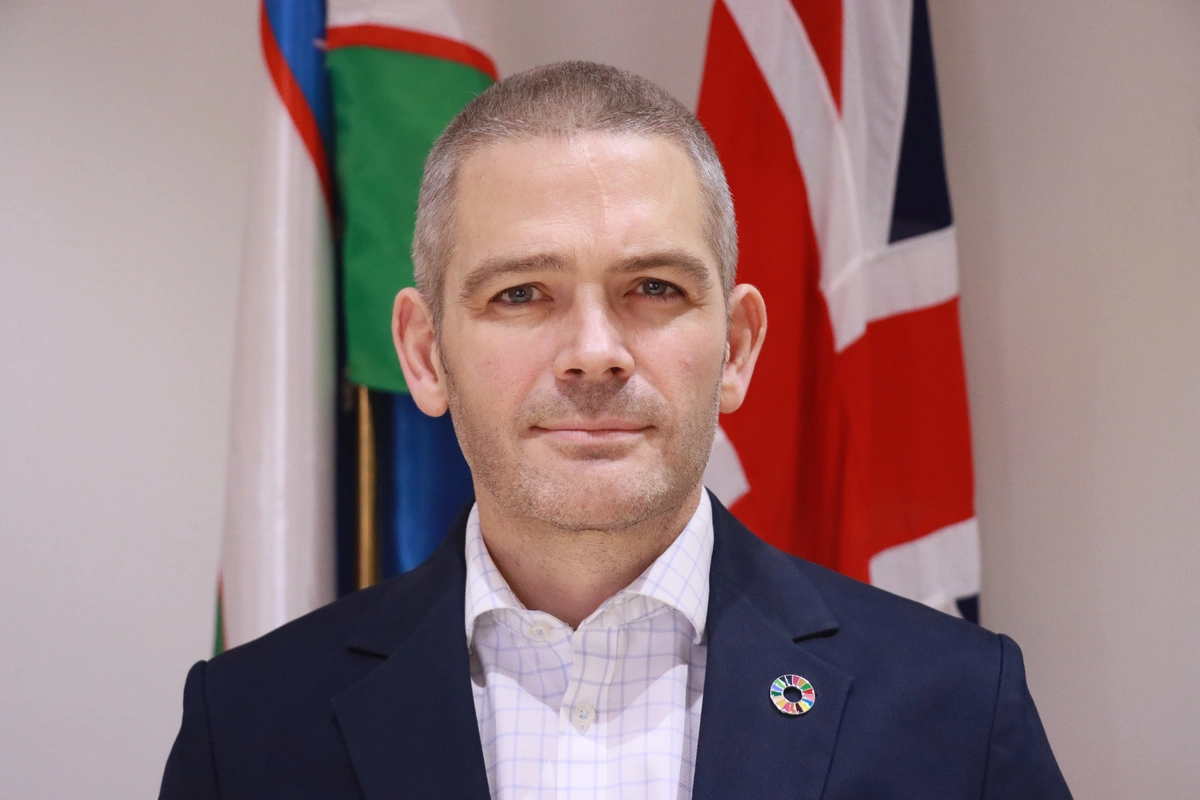
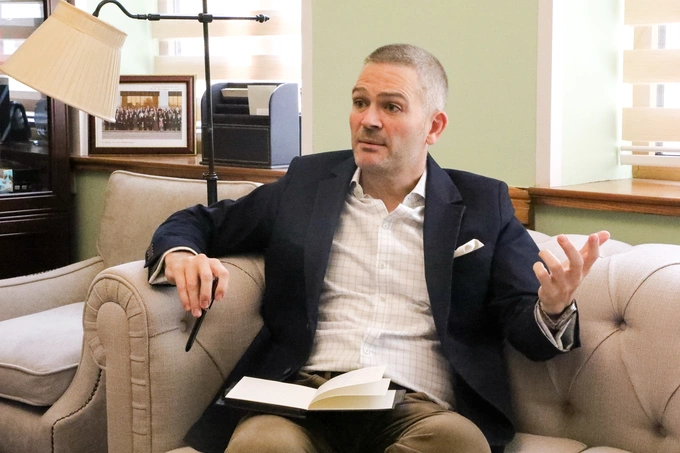
British Ambassador Timothy Smart is concluding his posting in Tashkent after serving as His Majesty’s Ambassador from 2023 to 2026. In a final interview with Gazeta.uz before his departure, Smart described a relationship transformed by trade growth, new financial and judicial institutions, expanded security cooperation, and a diplomatic calendar that now includes regular ministerial exchanges — though a long-sought leader-level summit between the two countries’ heads of government has yet to materialise.
Trade Growth and the London Listing
The most concrete measure of the mission’s output is the bilateral trade figure. When Smart arrived in 2023, trade between the two countries stood at £275 million. By the end of 2025 it had reached £2.1 billion, and the figure recorded to the end of July 2026 stood at £1.3 billion. Smart acknowledged that a substantial share of that total reflects British purchases of Uzbek gold, but said the overall trajectory represents genuine diversification and growth across the relationship.
A milestone in that financial relationship came in May 2026, when assets of the Uzbekistan National Investment Fund (UzNIF) were listed on the London Stock Exchange — the first such listing of Uzbek state assets on an international exchange of that scale. Smart described the moment as one in which major international investors and hedge funds were effectively asked whether they regarded Uzbekistan as a viable destination. He said the market had already given its answer, and expressed hope that the listing would build confidence for further offerings of Uzbek state assets in London, though he noted the choice of venue for future listings rests with Uzbekistan.
Beyond the exchange listing, Smart pointed to £4 billion in UK export financing made available specifically for Uzbekistan, and tens of billions of dollars available across the five Central Asian countries and Azerbaijan. He said London’s offer to Uzbekistan combines access to equity and debt capital markets, private finance, and Islamic finance — areas he described as consistently cited by Uzbek interlocutors as where British support can be most useful.
An International Commercial Court
One institutional development Smart singled out as significant for future investment flows is the creation of an international commercial court in Uzbekistan, modelled on similar bodies in Dubai and Astana. The court’s establishment was announced recently, and Smart said that from what he could observe it would be genuinely independent. He argued that such a court would allow arbitration to be conducted in Tashkent rather than routed through London, New York, the Gulf, or Astana, and that it would directly address a question he said British companies consistently raise: what legal guarantees exist in a market they do not yet know. Smart linked the court’s creation to Uzbekistan’s expected WTO accession and GDP growth running above 7 per cent as factors that are increasingly drawing British business attention to the country.
He framed investor confidence as resting on several interlocking conditions: the rule of law, institutional quality, the predictability of reform, and transparency requirements that come with an international exchange listing. He said Uzbekistan appeared to be moving away from being perceived as a frontier market and beginning to establish itself as a serious investment destination, though he was careful to attribute that assessment to the trajectory of recent years rather than a completed transition.
Security Cooperation and Territorial Integrity
Smart described the security dimension of the relationship as having expanded substantially during his posting. He said that before the current reform period, British engagement with Uzbek security institutions had been largely limited to English-language training. By the time he departed, cooperation extended to counter-terrorism, drone technology, mountain warfare tactics, work with the Prosecutor General’s Office on professional development, and coordination between the two countries’ security services. He also cited cooperation with the National Guard and the Ministry of Defence.
On the broader geopolitical question, Smart was explicit about Britain’s position on Uzbekistan’s sovereignty. He said that if any large power were to decide not to respect the territorial integrity of the region, that would matter to Britain as much as it matters to Uzbekistan. He connected that position to Britain’s status as a permanent member of the UN Security Council, and described the security relationship being built today as intended to ensure that no one could take Uzbekistan’s independence away. He also said Britain supported Uzbekistan’s multi-vector foreign policy and regarded it as a pragmatic and sensible approach, explicitly stating that London does not ask countries in the region to choose between partners.
Diplomatic Calendar and the Missing Summit
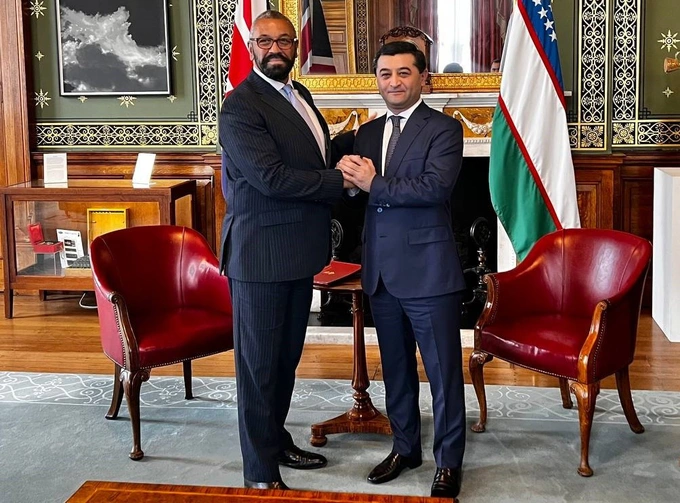
Smart described a diplomatic relationship that has become considerably more active at the ministerial level since the 2024 visit of then-Foreign Secretary David Cameron — the first visit by a British foreign secretary since Malcolm Rifkind in the late 1990s. Since then, Foreign Minister Bakhtiyor Saidov has met James Cleverly, David Lammy, and Yvette Cooper. In February 2026, London hosted the first meeting of Central Asian and British foreign ministers in a C5+1 format. Smart said two or three further ministerial visits were already scheduled for after his departure, and that the head of the Presidential Administration had visited the UK twice during his posting.
A delegation from Uzbekistan led by Deputy Prime Minister Jamshid Khodjaev is expected to travel to Britain in autumn 2026 to agree on new projects and roadmaps following meetings at the Tashkent International Investment Forum, where a British contingent of around 250 participants attended this year, led by Lord Jason Stockwood, the Minister for Investment. The chief executive of Standard Chartered Bank and the heads of the London Stock Exchange and UK Export Finance were among those present.
The one gap Smart acknowledged in the relationship is the absence of a leader-level summit. He said the willingness to hold such a meeting exists on both sides, and that former Foreign Secretary Cameron had been convinced of the need for the British Prime Minister and the Uzbek President to meet regularly — bilaterally and in a Central Asia-plus-UK format. The obstacle, Smart said, has been the frequency of British government changes: five prime ministers in five years. He expressed hope that his successor would be able to close that gap early in their posting, noting that a new Prime Minister had recently taken office.
Seasonal Workers and Remittances
Smart also addressed the Seasonal Worker Scheme, through which Uzbek citizens travel to the UK to work in agriculture and food processing. He said the British Home Office maintains threshold percentages for visa condition breaches above which a programme can be suspended, and that Uzbekistan had remained on the right side of that line throughout his posting, though it came close on one occasion before the issue was resolved. He attributed this to preparation work carried out with the International Organization for Migration and the Migration Agency, aimed at ensuring participants understand cultural differences, financial management, and what to do if problems arise. He noted a 62 per cent rise in remittances from the UK to Uzbekistan, which he described as a positive indicator that participants were returning home with savings to invest.
Areas Identified for Deeper Engagement
Looking ahead, Smart identified several sectors where he said British expertise could be more actively deployed. On energy, he pointed to small modular reactors as an area of British world-class capability relevant to grid stability as Uzbekistan moves toward renewables, and to wind power design. On transport, he cited Rolls-Royce’s Trent 1000 engine as an example of British aviation technology relevant to Uzbekistan’s ambitions to become a regional aviation hub. On agriculture, he described regenerative farming programmes that he said could reduce water use by a third while maintaining yields and eliminating dependence on industrial fertilisers, with pilot projects already running in Kyrgyzstan. He also pointed to British expertise in infrastructure design as relevant to the Trans-Caspian route and regional connectivity more broadly.
Smart described Uzbekistan’s regional integration under President Shavkat Mirziyoyev as a development of strategic significance, comparing the process of Central Asian countries binding themselves together economically to the formation of the European Community in the late 1950s. He said the railway through Kyrgyzstan into China, the Trans-Caspian route, shared electricity generation, and water cooperation were turning what could have been sources of regional tension into sources of strength.