



Listen to the article
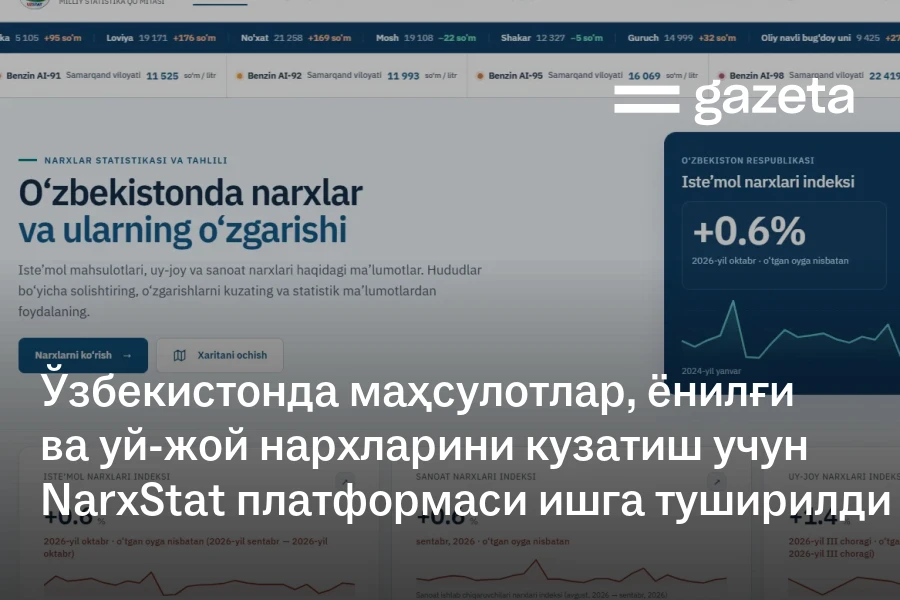
Uzbekistan’s National Statistics Committee has launched NarxStat, an open-access platform publishing consumer prices, inflation figures and commodity costs broken down by region, city and district across the country. The committee announced the service at a press conference on 13 November, with the platform going live shortly afterwards.
The platform covers a wide range of indicators: a consumer price index, weekly average prices for staple foods and five grades of petrol as well as propane and methane, a housing market price index based on listed asking prices rather than completed notarial transactions, and a producer price index for industrial goods. Users can track price movements across different periods, compare the cost of individual goods between regions, and download raw data in CSV and JSON formats. A registration-free application programming interface is also available for developers.
A central feature is an interactive map of Uzbekistan showing average prices by region and their week-on-week change. Historical data runs back to January 2021 for selected goods, and charts can be downloaded as animated GIFs. Two calculators are built into the platform: one assesses how the purchasing power of a given sum changed over a chosen period; the other calculates how the cost of a defined basket of goods and services has shifted.
What the Latest Numbers Show
The most recent National Statistics Committee data, published on the platform, show that consumer prices in Uzbekistan rose 0.6 percent in October 2026 compared with September. Annual inflation stood at 6.5 percent, down from 7.8 percent in October 2025. Prices have risen an average of 4.8 percent since the start of the year. Within October, food prices increased 1 percent, non-food goods 0.2 percent and services 0.6 percent.
Among individual products, the sharpest monthly price rises were recorded in aubergines and cucumbers, up 9 percent, tomatoes up 8.8 percent, bell peppers up 8.7 percent, potatoes up 5.3 percent and eggs up 5.2 percent. Lemons fell 15 percent, grapes 7.5 percent, apples 3 percent and sugar 2.2 percent. By region, annual inflation was highest in Tashkent city at 7.4 percent and lowest in Sirdaryo region at 5.5 percent.
Weekly price snapshots as of 11 November illustrate the platform’s granularity. Tomatoes rose 2,118 soums in a week to reach 12,421 soums per kilogram; cucumbers gained 1,915 soums to 12,725 soums; bell peppers added 1,552 soums to 11,548 soums; and AI-100 petrol climbed 712 soums to 26,940 soums per litre. Lemons fell 1,340 soums to 32,810 soums per kilogram and carrots dropped 193 soums to 4,582 soums. Fish, propane and chicken also edged lower.
Regional fuel price gaps are also visible. The national average for AI-92 petrol was 12,087 soums per litre, but the price reached 12,960 soums in Tashkent and fell to 11,539 soums in Karakalpakstan — a difference of 1,421 soums, or 12.3 percent. Methane averaged 5,505 soums per litre nationally, ranging from 5,710 soums in Tashkent to 5,262 soums in Samarkand region.
Egg prices showed the widest regional spread. The national average for ten eggs was 12,837 soums as of 11 November, but consumers in Surkhandarya region paid an average of 14,211 soums — with the Uzun district of that region recording the highest district-level average at 15,400 soums. Prices were lowest in Sirdaryo at 11,994 soums, Qashqadarya at 12,144 soums and Fergana at 12,183 soums.
Methodology and Context
From January 2026, the committee has applied an updated methodology for calculating the consumer price index, developed in line with international recommendations. Data are gathered from retail outlets, online cash-register records held by tax authorities, information from trading organisations and service providers, and internet sources. The committee notes that a statistical average price may differ from the price at any specific shop or market, depending on the composition of the product group monitored, product characteristics and the coverage of retail points.
NarxStat is not the first such tool in Uzbekistan. The Central Bank launched its own Narx Tahlili platform in April 2026, drawing on statistics-agency data to track prices of socially significant staple foods at national, regional and district level. The new committee platform extends that scope to housing and industrial goods and adds direct API access to underlying data, positioning it as a broader statistical resource for analysts, journalists and the public alike.