



Listen to the article
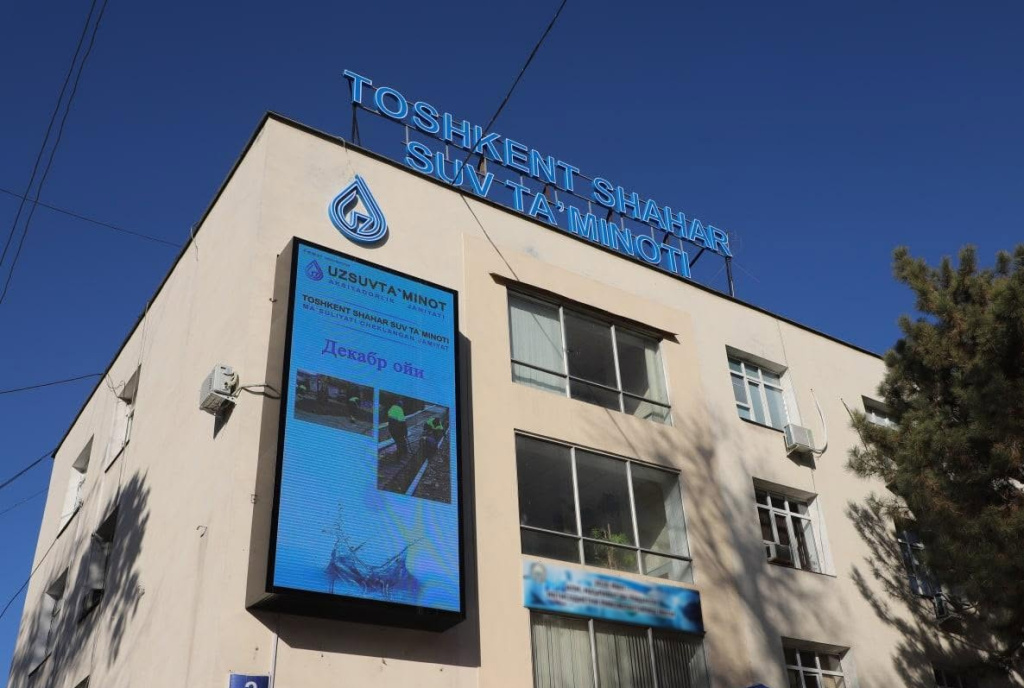
A Tashkent resident trying to sell a non-residential property he owns ran into an unexpected obstacle: the city’s water utility, AO Toshkent Shahar Suv Ta’minoti, refused to issue a debt-clearance certificate — a document required to complete the sale — unless he first installed an electronic water meter with remote data-transmission capability, at his own expense. The owner holds a water-supply contract as a private individual, not as a business, and says he carries out no commercial activity on the premises.
The utility’s written response, a copy of which was reviewed by Podrobno.uz, cited Presidential Decree No. PP-257 of 24 May 2022 as the legal basis. It acknowledged that the contract was concluded with the applicant as a natural person but argued that, because water is supplied to a non-residential property, the consumer falls into the third tariff group — and that this classification triggers the obligation to install a remote-capable smart meter.
What the Decree Actually Says
A reading of PP-257 does not straightforwardly support that interpretation. Sub-clause (v) of point 4 of the decree specifies that the obligation to install modern meters with remote data transmission falls on legal entities and citizens conducting entrepreneurial activity without forming a legal entity — in practice, registered sole traders. Owners of non-residential premises who are not registered entrepreneurs are not listed among those required to install such devices.
The decree also provides a tax incentive specifically for organisations and individual entrepreneurs who purchase qualifying meters: the cost of the device can be deducted from tax liability, up to four base calculation units per unit of equipment. That relief is structurally tied to taxpayers with entrepreneurial status. Separately, the decree states that from 1 January 2024, billing under the rules for consumers without metering devices applies to legal entities and sole traders who have failed to install remote meters — again, without separately naming private individuals who happen to own non-residential space.
Legal Analysis: Property Type Is Not Entrepreneurial Status
Lawyers at SherLegal, consulted by Podrobno.uz, concluded that a demand for a remote meter grounded solely in the non-residential designation of a property has no legal basis. They pointed to Article 24 of the Civil Code, which states that a citizen may engage in entrepreneurial activity without forming a legal entity only from the moment of state registration as an individual entrepreneur. Owning a non-residential property does not confer that status. Nor, the lawyers noted, does renting the property out: rental income received by a private individual is classified as property income and taxed under personal income tax rules, not as entrepreneurial activity.
On the utility’s tariff-group argument, SherLegal noted that point 51 of the Rules on Water Supply and Sewerage Services does allow a consumer to be reclassified when premises are converted to non-residential use, but specifies that the group is determined by the consumer’s primary type of activity — which must be established, not assumed from the property’s designation. Tariff-group membership affects the rate and billing method; it does not create entrepreneurial status.
The lawyers also identified a gap in the consumer classification rules themselves. The first group covers natural persons living in their own homes and flats; the second and third groups cover organisations. Private individuals who own non-residential premises but conduct no business are not explicitly placed in any category. SherLegal’s view is that this gap cannot be filled by an expansive interpretation that works against the consumer.
Even for legal entities and sole traders, the rules impose procedural constraints before billing penalties can apply. Under point 86¹ of the Rules, a water-supply organisation must issue a written warning at least 30 calendar days before switching a consumer to the higher tariff for absence of a qualifying meter. The utility’s response to the property owner contained no reference to such a warning having been issued. The lawyers also noted that the absence of a remote meter is not listed among the grounds for cutting off water supply under point 127 of the Rules.
Potential Liability for the Utility
The episode raises a broader question about accountability. Uzbekistan has no standalone penalty for misreading a law, but specific violations can attract sanctions. The Competition Law (No. ZRU-850 of 3 July 2023) prohibits abuse of a dominant market position. Article 18 bars dominant entities from imposing on counterparties conditions unrelated to the subject of a contract or collecting payments in breach of established procedures. Article 33 provides for remedies including compensation for damages and return of unjustified income; Article 42 allows, in certain cases, a fine of 5 percent of revenue. Whether the water utility holds a formally recognised dominant position and whether its conduct in this case constitutes a competition-law violation would require a separate regulatory assessment.
SherLegal recommends that any owner facing a similar demand first request a written justification from the utility specifying the exact legal norm requiring a remote meter, the evidence establishing entrepreneurial status or activity, and the grounds for imposing replacement costs on the owner. If the utility fails to provide that justification or declines to reconsider, the owner may complain to AO Uzsuv Ta’minot, the Ministry of Construction and Housing and Communal Services, the prosecutor’s office, or a court. Where inflated charges have already been applied, a recalculation can be demanded.
The case illustrates how a utility’s internal classification system — designed to sort commercial from residential consumers — can be applied in ways that impose business-grade obligations on ordinary residents, using a presidential decree as apparent cover for a reading the decree’s text does not support.