



Listen to the article
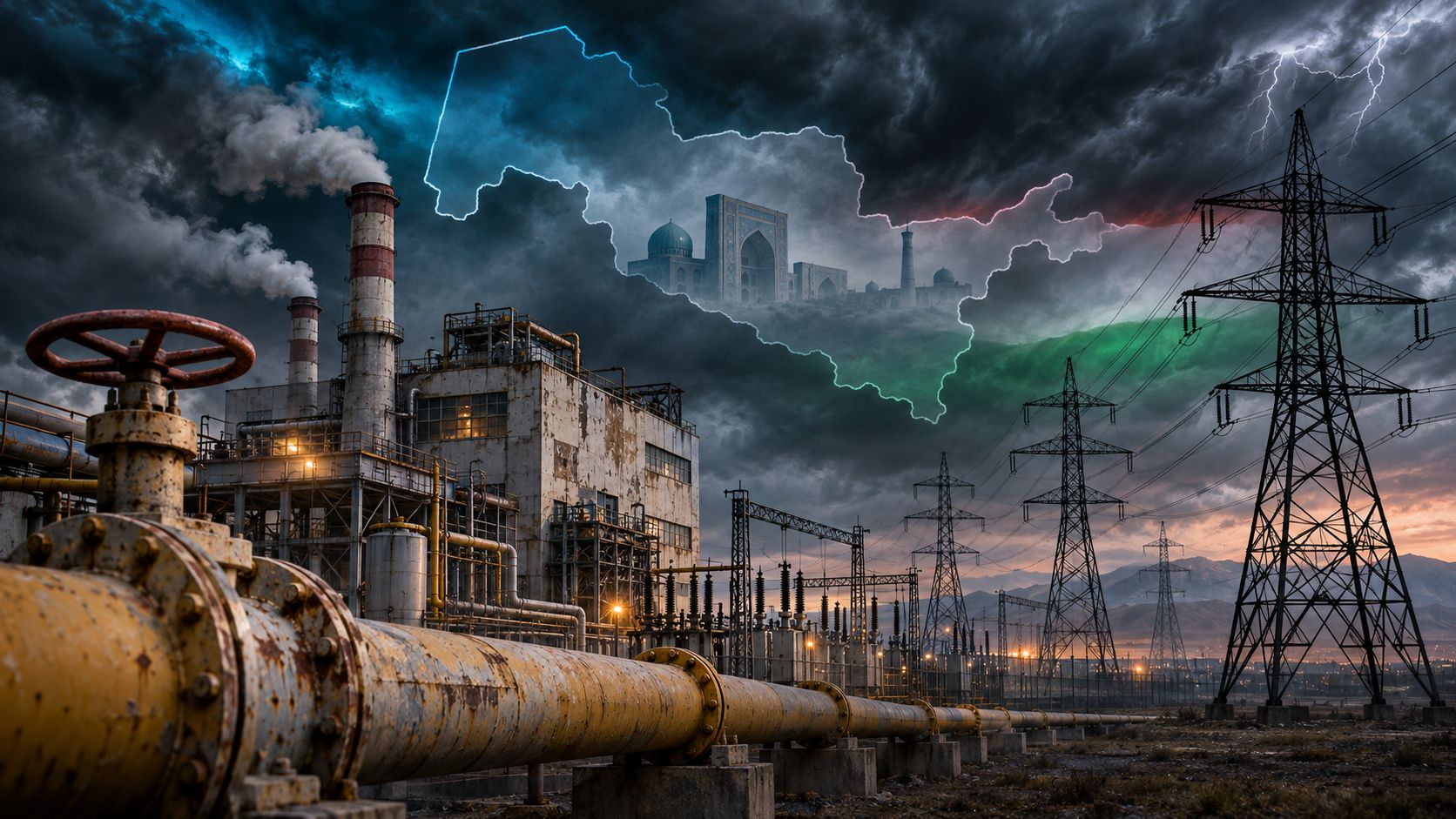
While rising energy prices have played a significant role in the recent U.S. midterm elections and continue to influence political debates across Europe, Uzbekistan and the broader Central Asian region are confronting an increasingly serious energy crisis — one that is partly the result of domestic shortcomings.
Over the past two months, Uzbekistan has secured approval for $300 million in loans from the World Bank and the Asian Development Bank to modernize its energy system. The financing highlights the growing challenges facing the country’s energy sector as three simultaneous crises expose its underlying vulnerabilities.
Growing Exposure to Global Energy Disruptions
The first challenge stems from U.S. President Donald Trump’s war against Iran, which has disrupted maritime shipping through the Strait of Hormuz and pushed Brent crude prices above $100 per barrel.
Countries that are net energy exporters or have successfully diversified their energy production away from fossil fuels are better positioned to withstand such disruptions. Uzbekistan, however, finds itself in neither category.
Having been a net energy exporter as recently as 2019, Uzbekistan has seen its dependence on net energy imports rise to 28 percent and continue growing as production from its domestic gas fields declines sharply.
Renewable energy currently accounts for only 19 percent of the country’s electricity generation. Despite possessing substantial uranium reserves, Uzbekistan does not yet generate nuclear power, although plans are underway to construct its first nuclear power plant within the next decade.
Russia’s Energy Crisis Adds Further Pressure
The second major challenge comes from Russia, Uzbekistan’s principal energy partner, which is experiencing significant difficulties within its own energy sector.
Ukrainian strikes have disrupted more than a quarter of Russia’s refining capacity, affecting the production of gasoline, diesel and aviation fuel.
Although these attacks have not interrupted Russian pipeline gas deliveries to Uzbekistan, the country remains vulnerable to disruptions in Russian fuel supplies.
Russia supplied more than a quarter of Uzbekistan’s gasoline, and the consequences of the strikes contributed to record-high fuel prices across the country in July 2026.
The transition toward electric vehicles also remains relatively limited. Electric vehicles account for just 8 percent of new car sales in Uzbekistan, compared with 55 percent in neighboring China.
Domestic Failures Threaten Long-Term Energy Security
The third crisis, arguably the most consequential for Uzbekistan’s future, originates within the country itself.
Years of insufficient investment and inadequate modernization have prevented Uzbekistan from reducing energy costs, expanding production, improving operational efficiency and building a more resilient energy system.
Uzbek President Shavkat Mirziyoyev has himself acknowledged the underlying problems, identifying “shortcomings, bureaucracy and corruption” as obstacles facing the sector.
Despite possessing natural gas reserves, Uzbekistan has consistently underinvested in its domestic gas industry, gradually increasing its dependence on Russian supplies.
Domestic natural gas production reportedly declined by an estimated 15 percent during the first quarter of 2026. Meanwhile, Uzbekistan expects its imports of Russian natural gas to increase by more than 40 percent this year.
Inefficiencies across the country’s energy distribution infrastructure further compound the problem. Electricity losses within Uzbekistan’s power grid have reached 17.2 percent, while losses across the natural gas network stand at 7.6 percent. Both figures remain considerably above international standards.
Decades of inadequate investment have left Uzbekistan with aging, deteriorating and inefficient energy infrastructure.
According to Mirziyoyev, modernizing this infrastructure will require approximately $8 billion over the next decade.
Securing investment on such a scale, however, will depend heavily on investor confidence in the country’s legal system and the protection of property rights — areas in which Uzbekistan has historically struggled.
International Investors Face Mounting Obstacles
The difficulties surrounding the Stone City Energy project illustrate the challenges international investors can encounter when operating in Uzbekistan.
France’s EDF, Germany’s Siemens Energy and Qatar’s Nebras Power joined forces under government auspices to invest in the €1.2 billion Stone City Energy gas-fired power plant project.
However, the companies subsequently encountered a complicated business environment in which securing fair and equal treatment proved difficult.
Over the past six months, the international consortium has faced a series of extraordinary obstacles.
Uzbekistan’s Prosecutor General’s Office launched an investigation into the international consortium, while the country’s energy minister was dismissed from his position and detained.
Following a legal complaint by Uzbek oligarch Batyr Rakhimov, an Interpol Red Notice was issued against Kakhramonjon Olimov, the project’s local sponsor. The notice was subsequently withdrawn.
At the same time, the natural gas field intended to supply the power plant became inoperable following a series of blowouts.
The combination of legal, administrative and operational uncertainty creates an environment that few major international energy companies would find reassuring.
If President Mirziyoyev intends to attract the $8 billion necessary to modernize Uzbekistan’s energy infrastructure, the country’s approach to international investors will need to change.
Weak enforcement of the rule of law increases investment costs and discourages modernization. International investors require predictable legal conditions, effective safeguards and protection against political interference.
Governance Reform Is Essential to Uzbekistan’s Energy Future
Uzbekistan cannot determine the course of the wars in Iran and Ukraine or prevent their consequences from reshaping global energy markets. It can, however, take measures to reduce its vulnerability to these external shocks.
President Mirziyoyev has correctly identified the seriousness of the country’s energy problems and the urgent need for substantial investment.
Addressing these challenges will nevertheless require comprehensive reforms extending beyond the energy sector itself.
Uzbekistan must undertake a fundamental review of its governance and judicial practices, ensuring that property rights are fully protected and that the rule of law is effectively enforced.
There are considerable reasons to remain optimistic about Uzbekistan’s future. However, fulfilling the country’s ambitions and unlocking its full potential will depend on its ability to resolve both its energy challenges and its longstanding governance issues.
Source: Based on the original analysis by Joël Ruet, published in The Diplomat.