



Listen to the article
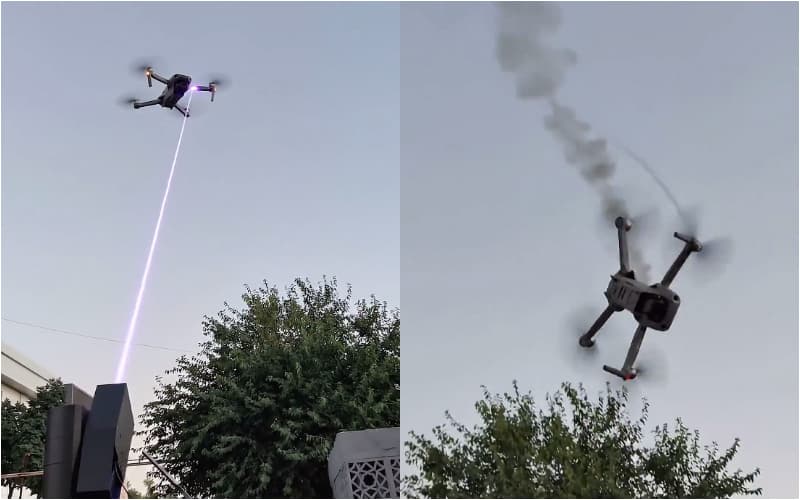
An Uzbek inventor has presented a prototype laser-based counter-drone system at a national engineering competition, claiming it can detect and neutralise an unmanned aerial vehicle at a distance of more than 1,000 metres in less than two seconds.
Ikromjon Muydinjonov showcased the ARGUS-SYS anti-UAV system at the Engineers of the Future review competition. According to the project’s own description, the system is designed for rapid response against drones, combining automated target acquisition with a high-powered laser.
How the system works
ARGUS-SYS relies on the YOLOv8 artificial intelligence algorithm — a widely used real-time object-detection model — together with optical transmitters to automatically detect and track airborne targets. Once a drone is acquired, a 500-watt laser operating at a wavelength of 405 nanometres is directed at it. The project claims the laser can disable a target within two seconds at ranges exceeding one kilometre.
A wavelength of 405 nanometres sits at the violet end of the visible spectrum. At 500 watts of continuous output, such a laser would represent a significant power level for a portable or semi-portable system, though the project description does not detail the platform’s size, weight or power source.
Competition context
The Engineers of the Future competition serves as a showcase for emerging technical talent in Uzbekistan. Muydinjonov’s entry reflects a broader global trend of developing low-cost or domestically produced counter-UAV technologies as small commercial and military drones have proliferated. The project is described as focused specifically on rapid-response neutralisation rather than surveillance or jamming.
The claims presented — sub-two-second disable time, kilometre-plus range — come from the project’s own documentation as submitted to the competition and have not been independently verified. No test data, third-party evaluation or institutional backing was cited in the competition materials.