



Listen to the article
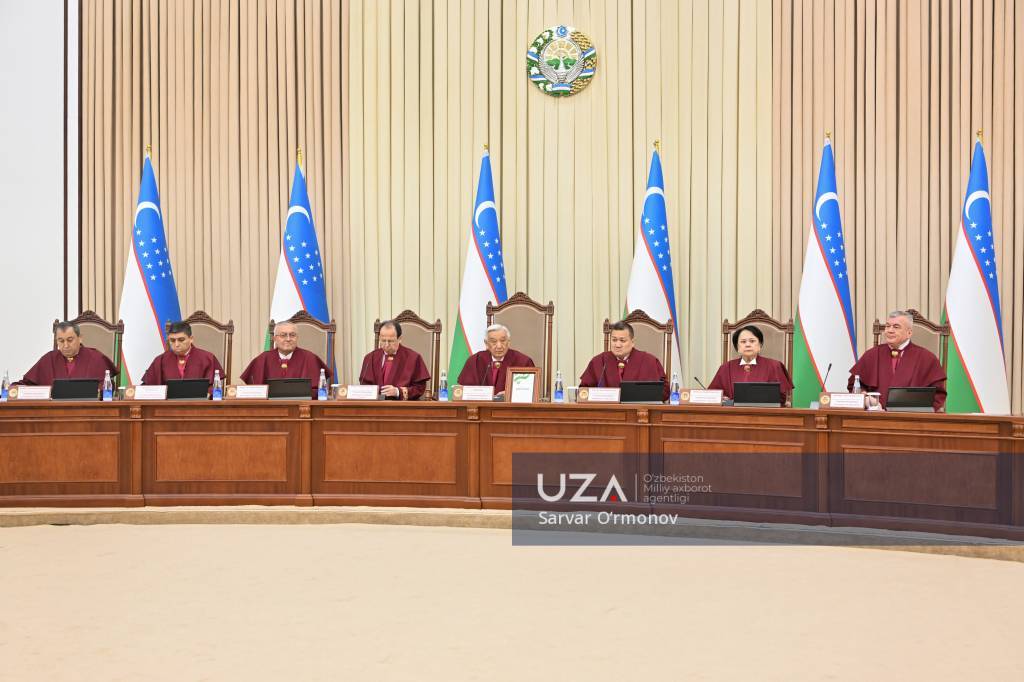
Uzbekistan’s Constitutional Court convened on 12 November to examine whether a provision of the Code on Administrative Responsibility conflicts with the Constitution, adjourning the session until 17 November after hearing arguments from multiple state institutions and legal experts.
The case centres on Article 324-39, part six of the Administrative Responsibility Code, which allows a single Supreme Court judge to review an administrative offence case at the supervisory level and issue a final ruling. Petitioners told the court that no mechanism exists to challenge that ruling further — a gap they contrasted with supervisory-instance decisions in other branches of judicial procedure, where review mechanisms do exist.
The petitioners argued that persons held administratively liable are thereby deprived of a safeguard available to defendants in other proceedings. More specifically, they contended that any doubts about a person’s guilt that remain unresolved at the supervisory stage are settled definitively by a single judge without any subsequent scrutiny, which they said breaches the presumption of innocence.
The court heard the case against several constitutional provisions. Article 28, part one of the Constitution states that an accused person must be provided with all opportunities to mount a defence. Article 54 designates the protection of human rights and freedoms as the state’s supreme purpose and obliges the state to guarantee rights enshrined in the Constitution and law. Article 55, part three guarantees everyone the right to have a violated right or freedom restored through examination by a competent, independent and impartial court within legally prescribed time limits.
Reporting judge A. Rakhimov presented the case to the bench. Representatives of the Supreme Court, the Prosecutor-General’s Office, the Ministry of Justice, the Bar Association, the Academy of Justice, the Academy of Law Enforcement, Tashkent State Law University, the Public Safety University and the Institute for Retraining and Advanced Training of Legal Personnel all attended and offered their views. Members of the Constitutional Court’s Scientific Advisory Council also spoke.
After hearing all submissions, the court announced a recess until 17 November, when deliberations are expected to resume. No ruling was issued at the 12 November session.