



Listen to the article
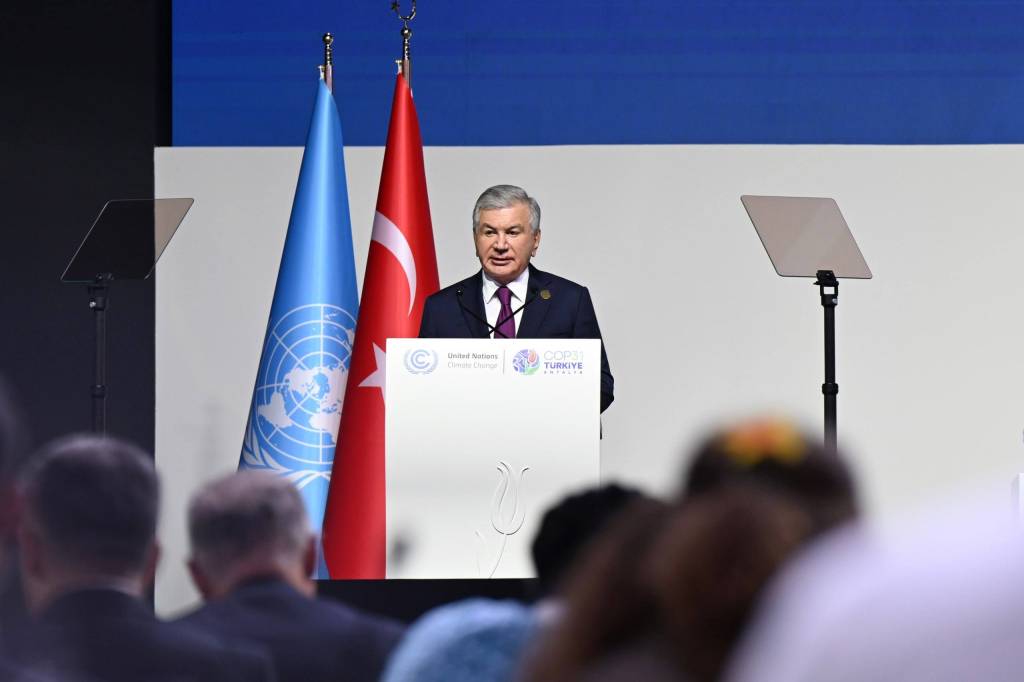
President Shavkat Mirziyoyev told the 31st Conference of the Parties to the UN Framework Convention on Climate Change on 11 November that Uzbekistan had met its target of reducing greenhouse-gas emissions per unit of GDP by 35 percent ahead of the original deadline, and announced a new national goal of cutting harmful emissions by 50 percent by 2035.
The address, delivered at COP31, ranged across water management, land restoration, waste investment and education before culminating in a formal proposal for a Central Asia Climate Integration Model — a regional cooperation framework built around three distinct pillars.
Water and land
Mirziyoyev said that over the past decade Uzbekistan had nearly halved the volume of water consumed by its economy and reduced withdrawals from river basins by one fifth. Water-saving technologies have been introduced on 60 percent of irrigated land, he said. On land restoration, he reported that forested area had been expanded by six million hectares, with one third of that gain in the Aral Sea region.
He also announced that Uzbekistan would assume the chairmanship of the International Fund for Saving the Aral Sea from next year, describing the role as a serious responsibility the country was prepared to fulfil at a high level.
Waste and education
A national waste-management strategy backed by more than three billion dollars in investment has been introduced, Mirziyoyev said, without specifying the source or timeline of that funding. On environmental literacy, he noted that one in every five Uzbek citizens is currently a schoolchild or university student, and projected that by 2050 three quarters of the population would have solid knowledge of nature conservation as a result of systematic ecological education.
A regional model with three pillars
The centrepiece of the speech was a proposal to develop what Mirziyoyev called a Central Asia Climate Integration Model, framed around shared threats — glacial melt, water scarcity and drought — that he said no single country could address alone and that required collective action from regional states.
The first pillar is informational: Mirziyoyev called for the creation of a climate-risk data-sharing infrastructure with the support of the World Meteorological Organisation.
The second is technological. He proposed transforming Uzbekistan’s annual Central Asia Eco Expo exhibition into a permanent platform for investment and technology transfer, focused on ecological solutions suited to the region’s specific conditions.
The third is financial. Mirziyoyev suggested that development banks and dedicated funds work together to design new support instruments for Central Asia, including concessional grants and what he described as “blue” and “arid” financing mechanisms — terms referring to water-related and dryland climate finance respectively.
The speech did not specify which states had been consulted on the integration model or whether any had formally endorsed it ahead of the session.