


Listen to the article
Rosatom, Russia’s state atomic energy corporation, is actively seeking business in Turkmenistan, a country that exports electricity to four neighbours and sits atop the world’s fourth-largest natural gas reserves — making it an unusual target for a nuclear energy sales campaign.
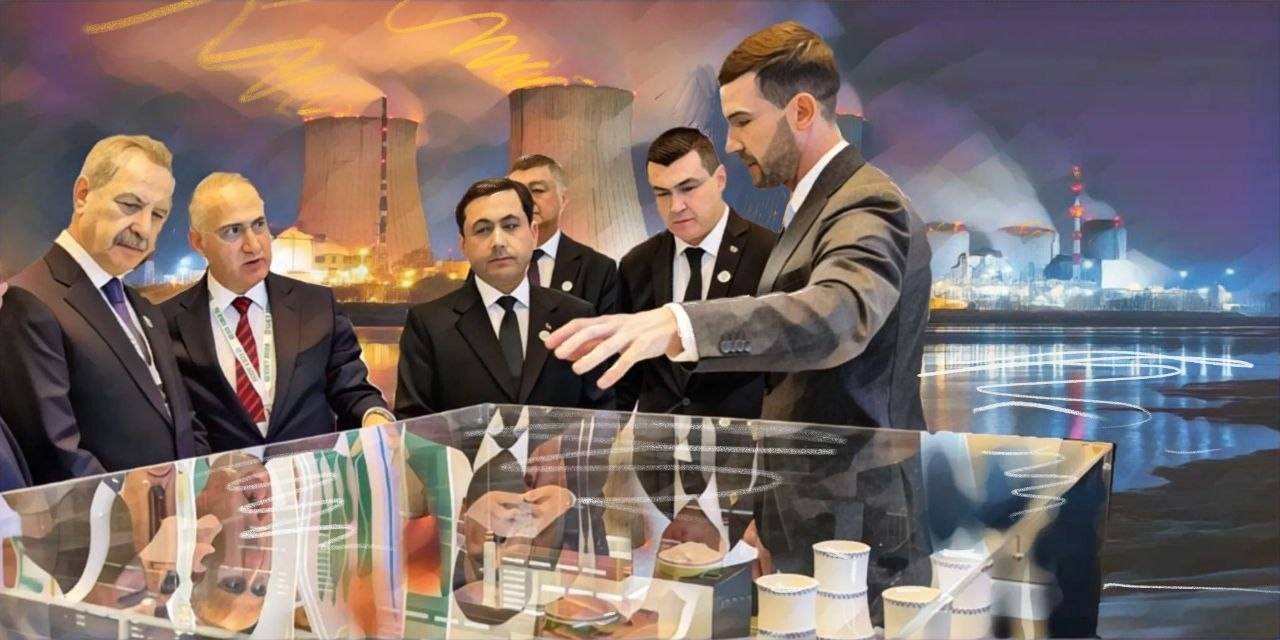
Representatives of the company attended a three-day international conference and exhibition on the development of Turkmenistan’s construction, industrial, chemical and energy sectors, held in Ashgabat from 3 to 5 November. More than 100 companies from 13 countries took part. Rosatom used the occasion to present a range of atomic energy projects to Turkmen officials.
Dmitri Konstantinov, Deputy Director of Rosatom’s Central Asia office, told attendees: “We would like to introduce our partners from Turkmenistan to Rosatom and share information about the modern technologies and projects we offer.” He argued that even countries with abundant energy resources benefit from diversifying their energy mix, and outlined Rosatom’s interest in small-capacity reactor units, wind farm construction and nuclear medicine cooperation. State corporation Turkmengeology reported on his remarks.
Turkmen officials who visited the Rosatom stand included Deputy Chairman of the Cabinet of Ministers Baymyrat Annamammedov, Energy Minister Annangeldy Saparov and Construction and Architecture Minister Abdulla Geldiyev.
A Seller in Search of a Market
Rosatom’s push into Turkmenistan reflects a broader strategic shift. Increasing Western sanctions imposed after Russia launched its full-scale invasion of Ukraine have sharply curtailed the company’s ability to sign new contracts in Europe and North America, redirecting its commercial attention toward Central Asia.
The company already holds a substantial regional footprint. In 2025 it won a tender to build two VVER-1200 reactors at Kazakhstan’s first nuclear power plant near Lake Balkhash, with construction expected to begin in 2027 — a project valued at approximately $16.5 billion. In Uzbekistan, construction has started on the country’s first NPP in Jizzakh Province; an original 2024 contract for six RITM-200N reactors was later revised to a hybrid configuration combining two RITM-200 units with two VVER-1000 reactors, at an estimated cost of $9.5 billion. Rosatom is also in talks with Kyrgyzstan about one or two RITM-200N small reactors and holds contracts with both Kyrgyzstan and Tajikistan to build wind and solar installations, while discussing small reactor possibilities with Tajik officials as well.
Turkmenistan would complete the set. A deal there would give Rosatom a presence in all five Central Asian states.
Why Turkmenistan Is a Hard Sell
The commercial logic is not straightforward. Turkmenistan exports roughly 35 billion cubic metres of gas to China annually and ships about 9 billion kilowatt-hours of electricity each year to Afghanistan, Iran, Kyrgyzstan and Uzbekistan combined. The country operates ten large thermal power plants — each rated at 254 megawatts or more — plus several dozen smaller facilities, and its authorities are actively seeking to expand both the volume and the destinations of those exports.
The country’s primary energy challenge is not generation capacity but infrastructure: an aging and partially degraded transmission network that causes the power outages Turkmen citizens have long endured. Electricity was provided free to citizens for most of the country’s 35-year post-Soviet history; that policy was abolished in 2019, but prices remain low. The 2022 census recorded a population of slightly more than seven million, though other sources put the figure closer to five million or below.
Given that Turkmenistan already produces a surplus it struggles to export, the case for adding nuclear, wind or solar generation is commercially ambiguous at best.
Competition and Regional Stakes
Rosatom is not without rivals in the region. China National Nuclear Corporation has been selected to build Kazakhstan’s second and third nuclear power plants, though project details remain under discussion. Uzbekistan has also signalled plans for two additional NPPs beyond the one already under construction, and the contracts for those plants have not been awarded.
The company’s global portfolio spans projects in 57 countries with a combined value exceeding $200 billion, according to the source material. Maintaining visibility in Central Asia — including in markets where immediate contracts are unlikely — is part of how Rosatom sustains that position against growing Chinese competition.
Whether Turkmenistan will ultimately see any benefit in nuclear or renewable energy additions to a grid already fed by abundant gas remains an open question. For now, Rosatom has established that it is ready to engage if Ashgabat ever decides the answer is yes.