



Listen to the article
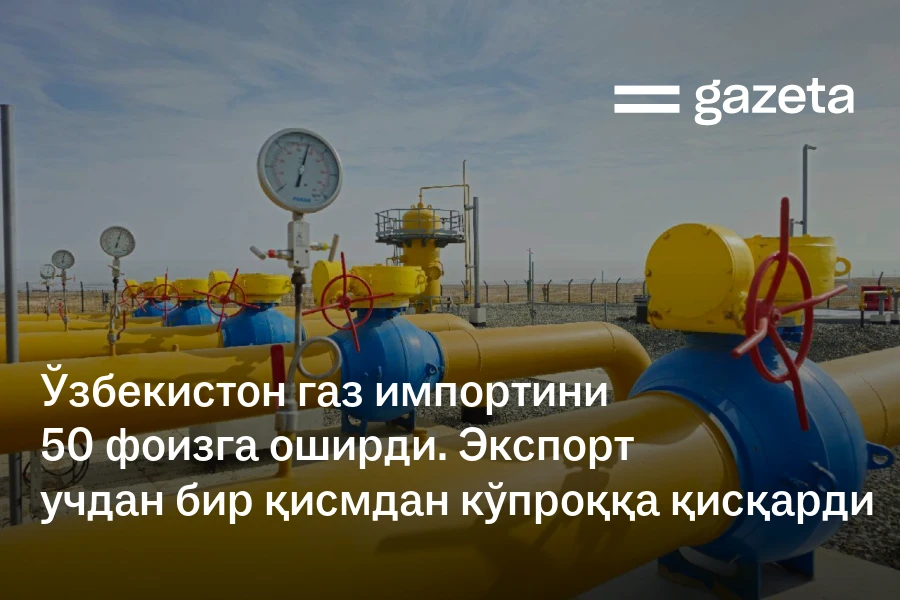
Uzbekistan spent roughly $1.605 billion importing natural and synthetic gas — including liquefied propane — in the first nine months of 2026, a 49.9 percent rise on the same period a year earlier, while gas exports fell by more than a third. The widening gap between what the country pays for gas and what it earns from selling it has reached $1.247 billion over nine months, more than double the roughly $524.5 million deficit recorded in the equivalent period of 2025, according to data from the National Statistics Committee.
The surge in import spending coincides with a sharp decline in domestic gas production. Uzbekistan extracted 27 billion cubic metres of natural gas in January–September 2026, down 16.4 percent — or 5.3 billion cubic metres — from the 32.3 billion cubic metres produced in the same period of 2025. Russia and Turkmenistan remain the principal suppliers of imported gas, though the Statistics Committee has not broken down physical volumes or contract values by country.
September Becomes the Year’s Costliest Month for Gas Purchases
Monthly import figures reveal an uneven pattern. Gas import spending fell to just $38.3 million in July before rebounding more than fivefold to $206.1 million in August. September then saw another near-doubling — an 88.8 percent jump — to $389.2 million, making it the single most expensive month for gas imports since January. That one month accounted for roughly 24.2 percent of the entire nine-month gas import bill.
On the export side, gas revenues have moved in the opposite direction. Uzbekistan earned approximately $357.9 million from natural and synthetic gas exports over nine months, down 34.5 percent from roughly $546.4 million a year earlier. Monthly export receipts peaked at $92.7 million in April, fell to $30 million in June, recovered to $46.8 million in July, and slipped further to $35.6 million in September. The September trade gap for gas alone — imports minus exports — stood at $353.6 million, more than double August’s $163.5 million.
China Data Confirm Sharp Drop in Uzbek Gas Deliveries
Figures from China’s General Administration of Customs independently corroborate the export decline. China imported $356.1 million worth of gas from Uzbekistan in January–September 2026, a 43.9 percent fall from $634.9 million in the same period of 2025. In September alone, Chinese customs recorded $50.04 million in Uzbek gas imports, up 4.8 percent from August’s $47.74 million but 27.1 percent below the $68.63 million recorded in September 2025.
A statistical discrepancy is worth noting. Uzbekistan’s own data show total gas exports of $357.9 million for the nine months, while China alone reports importing $356.1 million from Uzbekistan — a gap of only $1.8 million across the full period. In September, however, the divergence is striking: Uzbekistan reported exporting $35.6 million of gas to all destinations combined, while China recorded importing $50.04 million from Uzbekistan in that same month. The Statistics Committee has not explained the difference.
The committee also revised its 2025 baseline upward. An earlier report had put January–September 2025 gas imports at $932.3 million; the updated figure is approximately $1.07 billion, an increase of $138.6 million or nearly 15 percent. That revision reduced the apparent year-on-year growth rate for 2026 from an initial 72.2 percent to the current 49.9 percent.
Liquefied Gas, Oil Products and Electricity Round Out the Picture
Imports of liquefied propane gas rose nearly fourfold over the nine months, from roughly $40 million to $152.2 million. Petroleum and oil-product imports climbed 6 percent to approximately $1.56 billion, with petrol up 33.6 percent to $454 million and diesel falling 19.1 percent to $189.1 million. Coal, coke and briquette purchases totalled $144.2 million, a marginal 1.7 percent decline.
Electricity trade moved in a more favourable direction. Uzbekistan’s electricity exports rose 26.9 percent to $145.8 million while electricity imports fell 25 percent to $61.8 million, producing a positive trade balance of $84 million — up from roughly $32.5 million a year earlier. In September, the country exported $6.6 million of electricity and imported $4.3 million.
Taken together, the data sketch a country whose energy trade is being reshaped by falling domestic output and rising import dependence. Broader mineral-fuel imports — covering all hydrocarbons and lubricants — rose 21.6 percent to $3.37 billion over nine months, while overall mineral-fuel exports edged up just 4.4 percent to $1.18 billion, leaving a widening structural gap that gas accounts for overwhelmingly.