



Listen to the article
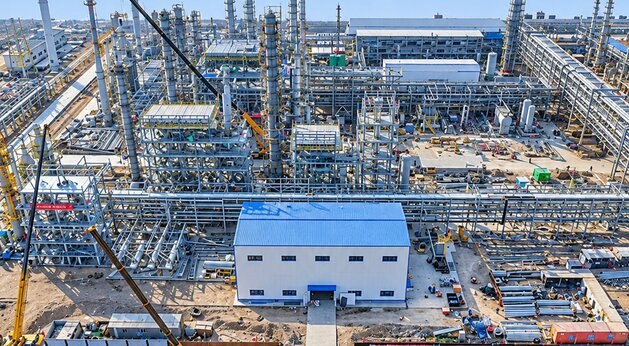
Residents of Kara-Balta, a city roughly 60 kilometres west of Bishkek, have raised persistent complaints about allergies, hair loss and high blood pressure they associate with the Junda oil refinery — Kyrgyzstan’s largest — even as the Chinese-owned plant undergoes a major modernisation that has already overrun its budget and missed its completion deadline.
At a public meeting on 8 November, a local woman asked President Sadyr Japarov to either close the plant or compel it to install better pollution controls. Japarov declined to order a shutdown, arguing that Kyrgyzstan needed to develop its industries and produce more of its own fuel. He did say his government would consider relocating residents if living near the refinery was demonstrably harming their health.
A Refinery With a Troubled History
The plant, operated by the locally registered China Petrol Company Junda — 99 percent owned by China’s Central Asia Energy Company, with Kara-Balta’s DaDe Service Company holding the remaining one percent — began producing fuel in 2014. It shut down in early 2020 after repeated complaints about odours and air pollution, then resumed operations in 2024. Its annual crude-processing capacity stands at 800,000 metric tons, and the company says a fully upgraded plant could cover more than 35 percent of domestic demand for fuels and lubricants.
Kyrgyzstan has a clear strategic interest in keeping the refinery running. The country is trying to reduce its dependence on Russian gasoline and diesel by refining more crude at home, and Junda is central to that ambition. The upgraded plant is designed to produce K4- and K5-grade fuels, which carry tighter limits on sulfur content than current output.
Costs Rise, Deadlines Slip
The modernisation project has grown steadily more expensive. Estimates stood at roughly $160 million in 2024, rose to $167 million in 2025, and the National Investment Agency now puts the figure at $193.75 million. The project missed its 31 July 2026 completion deadline; on 25 August the agency and the Chinese investor signed an agreement covering the next phase, and an environmental inspector told an October briefing that work was expected to finish by April 2027. The agency has given no date for the upgraded plant to enter commercial service.
After visiting the refinery on 11 November, agency head Ravshanbek Sabirov called on the investor to honour its commitments. The same day, Junda issued a statement saying its modernisation was nearing completion. The company said it was installing a vapour recovery system designed to capture petroleum vapours during storage and transport and return them to the production process, and that it planned to plant trees across roughly two hectares of refinery land in spring 2027.
Inspections prompted by residents’ complaints have so far resulted in two fines and orders to correct violations, officials said at the October briefing. Kyrgyzstan’s environment ministry published air quality readings for Kara-Balta in September; some spring measurements of nitrogen dioxide exceeded the daily average limit, while sulfur dioxide remained within limits in spring and summer. The ministry did not attribute the elevated readings to Junda. The company’s own statement cited no independent emissions measurements or medical studies examining residents’ symptoms, leaving the direct link between the plant’s operations and the health complaints unestablished.