


Listen to the article
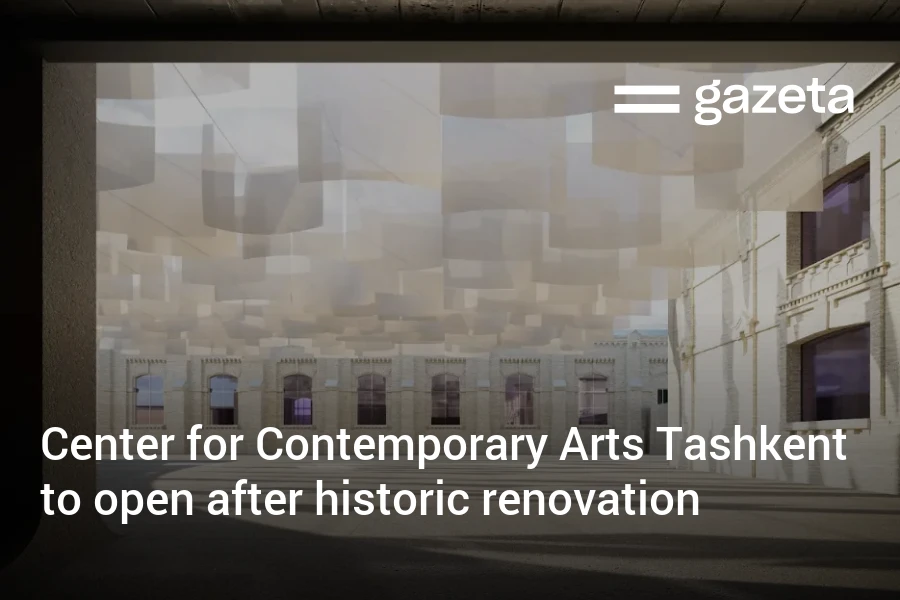
Tashkent’s Center for Contemporary Arts (CCA) will open its doors on 21 March, marking the end of a renovation that began in 2021 and ran two years beyond its original 2023 completion target. The institution occupies a former industrial building dating to 1912, which served as the city’s first diesel power station before the revolution.
Founded in 2019, the CCA operated on a trial basis before closing for works. The concept for the renewed space was unveiled as a scale model by French architectural firm Studio KO at Art Basel Paris in October 2025. According to Uzbekistan’s Art and Culture Development Foundation, the centre will be the country’s first permanently operating institution dedicated to contemporary art, research and public engagement. Admission will be free, and the building will house a library, workshops and a café.
“When we first envisioned the center, it was important to me that the space be open to everyone and serve as a place for inspiration, dialogue, and opportunity, as well as a meeting point for the city’s community,” said Gayane Umerova, chairperson of the Art and Culture Development Foundation. The CCA’s year-round programme will be led by artistic director and chief curator Dr Sara Raza, with a stated focus on supporting Uzbek artists, hosting international exhibitions and promoting local talent abroad. The foundation also plans to use the centre as a platform for artistic residencies, internships and educational initiatives.
Opening exhibition: Hikmah
The inaugural exhibition, Hikmah — an Uzbek word meaning “wisdom” — will run from 21 March to 30 June, curated by Dr Raza. It will present works created in direct dialogue with the building and its architecture. Artists include Muhannad Shono from Saudi Arabia, Nari Ward from the United States, Shohrukh Rakhimov from Uzbekistan, and Tarik Kiswanson, who holds Swedish and French nationality. The show will also feature a work by Nadia Kaabi-Linke from the Guggenheim Museum collection, alongside pieces by Kimsooja of South Korea and Ali Cherri, and works drawn from the I. V. Savitsky State Museum of Art by Vladimir Pan, Daribay Saipov and Bakhtiyar Saipov.
Venice and beyond
Between May and November, the CCA will present an exhibition dedicated to Vyacheslav Akhunov, described by the foundation as one of the leading figures of Uzbek modernism, as part of the parallel programme of the 61st International Art Exhibition of the Venice Biennale. The show, titled Instruments of the Mind and also curated by Dr Raza, will be held at Palazzo Franchetti in Venice.
In September, the centre will host Kabakov: The Centre for Cosmic Energy, a site-specific solo exhibition with guest curator Zelfira Tregulova. The foundation describes the project as transforming the building into a “living laboratory of art and speculative parafictions,” drawing on numerology, cosmology and symbolic systems from Central and West Asian cultures. The exhibition will incorporate performances, live music, gastronomic events, film screenings, poetry and storytelling.
Architecture school and summer festival
In April, the CCA will launch the first cohort of the Architectural Association Visiting School Uzbekistan, the opening year of a three-year programme running through 2028 in partnership with the Architectural Association in London. The initiative will bring together architecture and urban studies students, young architects, researchers, artists and curators, with the aim of advancing research into traditional architectural thinking in Uzbekistan. Annual exhibitions and a shared body of research are planned as outputs.
From 21 June to 9 August, the centre will co-organise Tashkent Summer Days, a seven-week arts festival developed with Invisible Island Studio, founded in 2023 by Tashkent-based photographer Hassan Kubanbaev and creative producer Misha Kuzhel. The festival will span all districts of the city and several makhallas, drawing on historic urban celebrations and film programmes. It will also seek to revive the legacy of the Tashkent International Film Festival, which ran from 1968 to 1988 and was once regarded as a significant platform for global cinema.