



Listen to the article
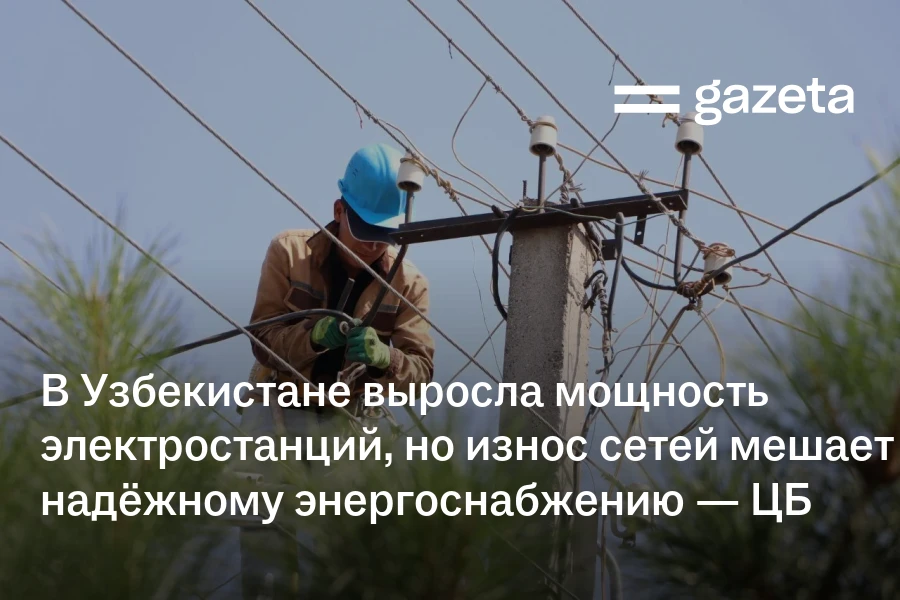
Uzbekistan has expanded the installed capacity of its power stations by 50 percent over the four years to 2025, yet the electricity grid remains too worn and congested to deliver that power reliably — a structural bottleneck that the Central Bank now identifies as a direct threat to its inflation targets.
The warning appears in the bank’s draft conceptual framework for monetary policy in 2027–2029. The document argues that generation growth means little without parallel investment in transmission and distribution, and that repeated outages raise production costs across the economy, feeding price pressure that monetary tools alone cannot suppress.
The Scale of the Problem
The numbers behind the concern are stark. At a presidential meeting on 27 July, officials reported roughly 4,000 faults in the electricity network during June and July 2026 alone. In some regions, households and businesses went without power for eight to ten hours at a stretch. Network losses stood at 17.2 percent of electricity transmitted; over the first six months of the year, the volume of energy lost in the grid reached 4.8 billion kilowatt-hours.
The World Bank had flagged the same vulnerability in May 2025, noting that more than half of Uzbekistan’s distribution network assets had been in service for over thirty years. The bank estimated technical losses in distribution networks at around 13 percent in 2024, attributing them to ageing equipment and overloaded infrastructure, and warned that without grid renewal the system would be unable to absorb the additional renewable capacity being built.
President Shavkat Mirziyoyev raised the issue at a 23 February 2026 meeting, cautioning that without new high-voltage transmission lines, generation capacity could outpace what the grid can carry. He noted that spending allocated in 2025 for grid development had been drawn down too slowly. Measures announced at that meeting included three high-voltage lines totalling 602 kilometres, and in Tashkent specifically: 75 kilometres of new high-voltage lines, five new substations, upgrades to 69 kilometres of existing lines and 18 substations, and the renewal of 638 kilometres of low-voltage network and 161 transformer points.
Financing the Fix
The Central Bank’s document notes that over the past decade, 30 trillion soums have been directed toward modernising electricity and gas networks, substations, transformers and gas distribution infrastructure — a figure that illustrates the scale of past investment while implying it has not been sufficient.
International lenders are now stepping in with larger, targeted programmes. In May 2025 the World Bank approved a concessional loan of $100 million for distribution infrastructure, to be supplemented by $50 million from the company Regional Electric Networks. The combined $150 million programme, spread over five years, covers the construction and upgrade of 6,000 kilometres of low-voltage distribution lines, the installation or replacement of 1,200 transformers, and the rollout of metering and network-management systems including 150,000 smart meters and 4,000 automated data-collection devices.
In October 2026 the World Bank announced financing for a second, larger programme worth $371 million, focused on modernising and digitalising 60 key substations nationwide. The Asian Development Bank will contribute $200 million, the World Bank $100 million, and Uzbekistan itself $71 million; the programme will be implemented by National Electric Networks of Uzbekistan. By 2031, the substation upgrades are expected to cut annual energy losses at those facilities by 20,000 megawatt-hours and create the grid headroom needed to connect an additional 3.3 gigawatts of renewable capacity.
The World Bank has estimated that modernising and expanding Uzbekistan’s distribution networks through 2030 will require approximately $3 billion in total.
The Inflation Connection
The Central Bank’s framing is deliberate. The bank’s baseline forecast projects inflation falling to 5 percent in the second half of 2027, but the document warns that persistent outages and tariff-driven cost increases could force the bank to keep interest rates higher for longer. Power cuts stop production lines, push firms toward expensive backup generators and raise unit costs; if supply cannot keep pace with demand, prices rise.
The bank is equally candid about tariffs. Moving energy prices toward economically justified levels creates the revenue base that utilities need to invest, but it also increases costs for households and businesses. The Central Bank argues that any tariff increase must therefore be accompanied by measurable improvements in service quality, lower technical losses and better management — otherwise the bank may face a prolonged period of tight monetary policy to contain the inflationary spillover.
To help consumers and firms plan, the bank has proposed publishing multi-year tariff schedules in advance — a recommendation it has made separately in other policy documents. The draft monetary-policy framework makes clear that grid reliability and tariff transparency are not peripheral infrastructure questions but conditions for achieving the price stability the bank is mandated to deliver.